
Sump pump
Sump Pump + Battery Backup Calculator
Cost calculator for primary sump pumps and battery-backup combo systems. Sized by basement flood risk and outage frequency.
Quick answer: basic primary 1/3 HP pump $430–$1,030 installed. Combo primary + battery backup $900–$2,500. Smart WiFi combo $1,300–$3,300. Battery backup is the highest-value addition for any finished basement.
Optional — auto-sets state
Installed cost · Combo primary + battery backup · Illinois
$1,598
range $956 – $2,668
Good match for your risk profile
See the single most-likely cost and the realistic range it falls in — not just a low/high band.
- ~30%Concrete cut for a new pit / basin+$400–$1,500
- PossibleDischarge line re-route or freeze protection+$200–$900
- PossibleDedicated GFCI circuit added+$150–$600
Surprise odds are approximate planning estimates, not measured rates; cost ranges are sourced where shown. How this works.
Method: each cost line is drawn from a triangular distribution and correlated by a shared market factor (~0.5), then sampled across 10,000 outcomes (a Monte Carlo simulation); the most-likely value and range emerge from the simulation, not the band. A planning simulation, not a quote.
New to sump pumps?
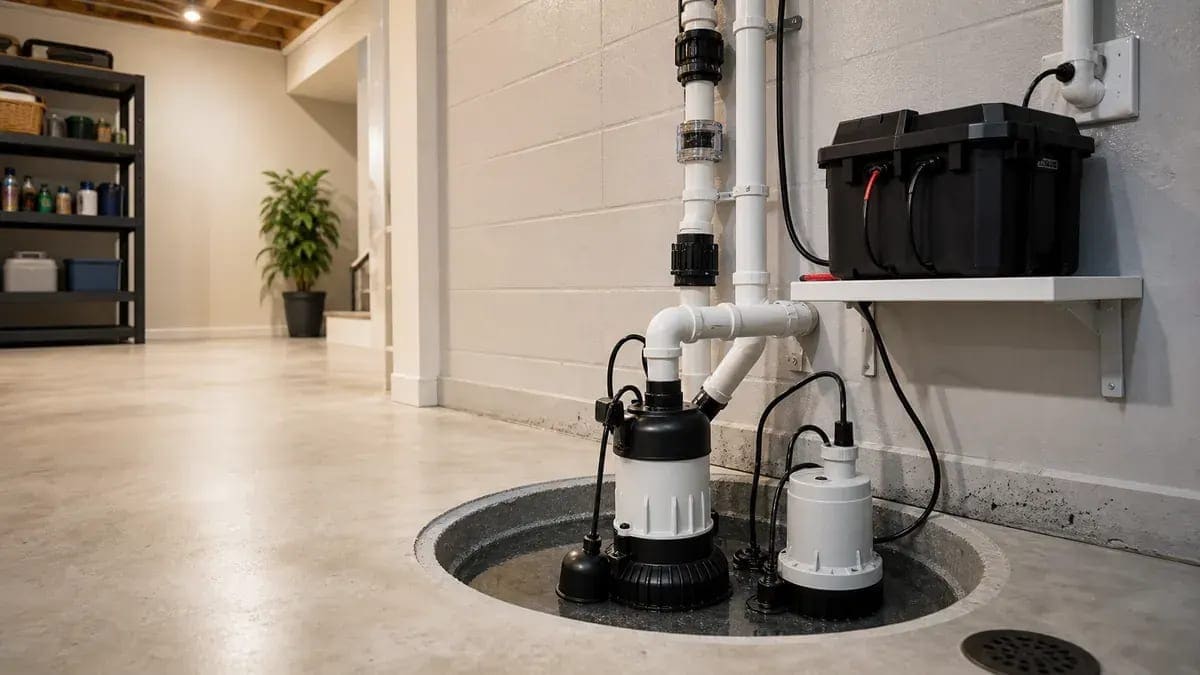
A sump pump sits in a pit at the lowest point of a basement and ejects water that collects from foundation drains or groundwater. Primary AC pumps run on house power; battery backups run on DC during outages. The capacity that matters most isn’t horsepower — it’s redundancy. Power loss during a major storm is the most common failure scenario.
Frequently asked questions
How much does a sump pump cost installed?
Basic primary 1/3 HP: $430–$1,030. Heavy-duty 1/2 HP: $580–$1,450. Battery backup only (DC, add to existing): $450–$1,350. Combo primary + battery backup: $900–$2,500. Water-powered backup: $430–$1,400. Smart WiFi combo with monitoring: $1,300–$3,300.
Do I need a battery backup?
If your basement is finished, has valuable contents, or you live in an area with frequent storms or outages, yes. The most common sump-pump failure mode is the same storm that floods your basement also knocks out grid power. A DC battery backup runs 4-8 hours of continuous pumping or 24-72 hours of intermittent pumping. Battery replacement every 4-5 years.
Battery backup vs water-powered backup?
Battery backup: works during long outages but battery degrades over time and needs replacement. Water-powered: uses municipal water pressure (no battery), works as long as city water flows, but wastes ~1 gallon of city water per 2 gallons pumped — and only works if you’re on city water (not well). For most homeowners, battery backup is the safer choice.
How much does a sump pump battery backup cost?
A DC battery backup added to an existing primary pump runs $450–$1,350 installed (the backup pump, controller, battery, and labor). A new combo system — primary pump plus integrated battery backup — runs $900–$2,500 installed. A smart WiFi combo with phone alerts and self-testing runs $1,300–$3,300. The battery itself is $150–$400 and is replaced every 4–5 years; budget that as an ongoing cost.
How long does a sump pump battery backup run during a power outage?
A typical AGM deep-cycle battery backup pumps for roughly 4–8 hours of continuous run, or 24–72 hours of intermittent cycling (the realistic storm scenario where the pump runs a minute every few minutes). Runtime depends on battery amp-hours, pump draw, and how often the float switch trips. Lithium (LiFePO4) backups cost more but hold capacity longer and tolerate more charge cycles.
What should I look for in a battery backup sump pump?
Prioritize: (1) adequate battery amp-hours for your outage risk, (2) a maintenance-free AGM or lithium battery over flooded lead-acid, (3) a controller with low-battery and high-water alarms, (4) WiFi monitoring if the basement is finished or you travel, and (5) a pump GPH rating that matches your pit’s inflow. The backup pump should be sized close to your primary so it can keep up during a real storm.