
Home battery
Home Battery Cost Calculator
Installed-cost estimate for residential battery storage. Adjusts by capacity, use case (backup / self-consumption / TOU arbitrage), chemistry, paired-with-solar status, and state incentives.
Quick answer: a 13.5 kWh Powerwall-class system installs for $13,000–$19,000 gross in 2026. Federal 25D (30%) expired after 2025-12-31; state programs (CA SGIP, CT Energy Storage, NY-Sun Storage, MD Storage Tax Credit) subtract $2,000–$7,500 where eligible.
Optional — auto-detects state
25D Residential Clean Energy Credit terminated by OBBBA for property placed in service after 2025-12-31.
Estimated installed cost · 13.5 kWh · California
$25,589
range $20,051 – $32,377 gross
Net after incentives (mid)
$23,564
Range $18,633 – $29,947
Payback
21.1 yr
TOU + resilience savings
Incentive stack
- Federal 25D (0%, ≥3 kWh)−$0
- CA SGIP (Equity Resiliency tier)−$2,025
- Self-Generation Incentive Program — General Market tier; higher tiers for low-income, fire-prone areas, medical baseline.
Federal 25D credit (30% standalone battery ≥3 kWh) was terminated by OBBBA for property placed in service after 2025-12-31. State programs vary; verify income tier and capacity caps with the program administrator.
Benefits estimate
- Annual TOU savings
- $1,064
- Resilience value
- $50/yr
- Useful cycles
- ~6,000 (LFP) / ~3,500 (NMC)
- Warranty (typical)
- 10 yr / 70% capacity
Resilience value is a conservative annualized figure; actual avoided-outage cost can be much higher during sustained outages or for medical-baseline households.
Quote check — what to ask
- · Usable capacity (not nameplate) and end-of-warranty capacity retention (typically 70-80%).
- · Round-trip efficiency (modern systems 89-92%).
- · Cycle warranty (10,000 cycles for LFP, 6,000-7,000 for NMC).
- · Backup loads and transfer time (whole-home transfer: ms to seconds; partial: instant via dedicated subpanel).
- · Whether the inverter is integrated (Powerwall 3, Franklin) or separate (Enphase requires separate IQ8 microinverters or System Controller).
- · Monitoring, software updates, and grid-services enrollment (Tesla VPP, Sunrun Connected Solutions, etc.).
- · Permit and interconnection lead time — typical 4–10 weeks in 2026.
See the single most-likely cost and the realistic range it falls in — not just a low/high band.
- ~40%Critical-loads subpanel needed for backup wiring+$1,000–$3,000
- ~20%Main panel upgrade for the battery interconnection+$1,800–$4,500
- PossiblePermit + utility storage interconnection delay+$150–$1,000
Surprise odds are approximate planning estimates, not measured rates; cost ranges are sourced where shown. How this works.
Method: each cost line is drawn from a triangular distribution and correlated by a shared market factor (~0.5), then sampled across 10,000 outcomes (a Monte Carlo simulation); the most-likely value and range emerge from the simulation, not the band. A planning simulation, not a quote.
New to home batteries?
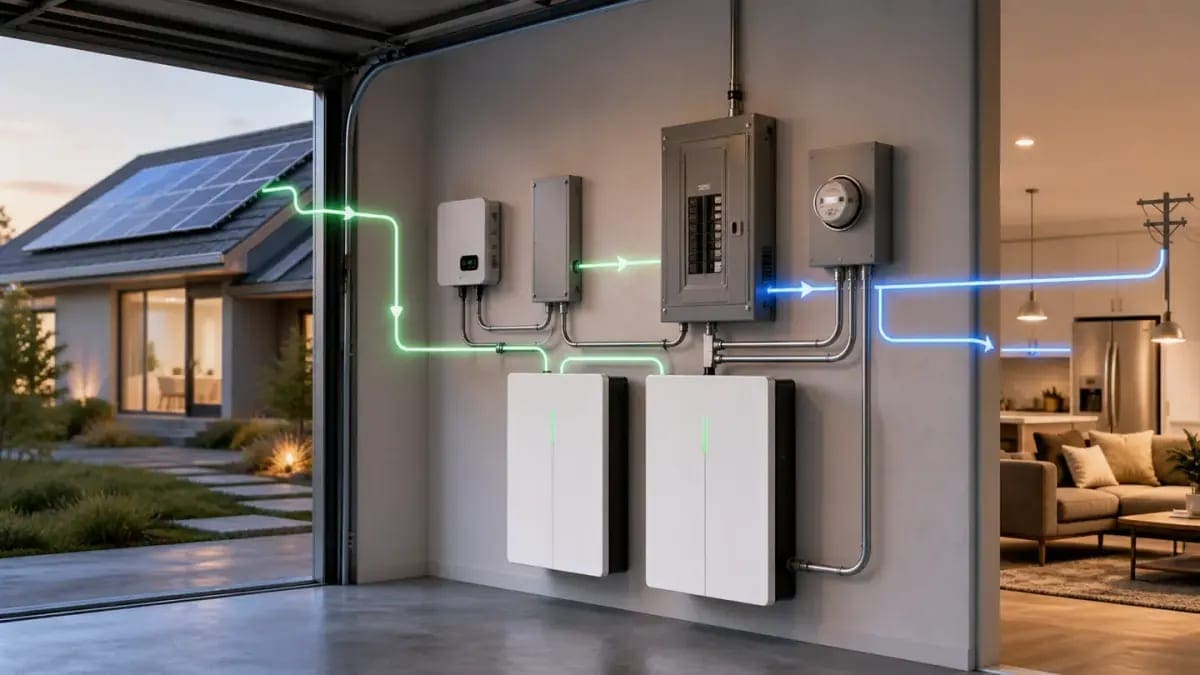
A home battery is a stack of lithium-ion cells, a battery management system, an inverter (or interface to your solar inverter), and a transfer switch. Modern systems use LFP chemistry — safer than NMC and warrantied for 6,000-10,000 cycles. The three reasons to install one are outage backup, self-consumption of midday solar production (especially under CA NEM 3.0 export rates), and time-of-use arbitrage. The federal 25D credit (30% for standalone batteries ≥3 kWh) was terminated by OBBBA for property placed in service after 2025-12-31; state programs (CA SGIP, NY-Sun Storage, CT, MD) still apply where eligible.
Read the full guide 11-min read · chemistry · sizing · backup vs arbitrage · permitting · brand-by-brand
Frequently asked questions
How much does a home battery cost installed in 2026?
A Powerwall-3 class system (13.5 kWh, integrated inverter) installs for $13,000–$19,000 gross. The federal 25D credit (30% for standalone batteries ≥3 kWh) expired after 2025-12-31 under OBBBA. State programs (CA SGIP, NY-Sun Storage, CT Energy Storage Solutions, MD Storage Tax Credit) still apply where eligible. Smaller modular systems (Enphase IQ Battery 5P at 5 kWh) start around $6,000–$8,000 per unit.
Is there a federal tax credit for batteries in 2026?
No. The Inflation Reduction Act expanded the Residential Clean Energy Credit (Section 25D) to cover battery storage ≥3 kWh, including standalone installs. OBBBA (July 2025) terminated 25D for property placed in service after 2025-12-31. Batteries with a 2025 placed-in-service date still qualified for the 30% credit on the 2025 return. Source: IRS https://www.irs.gov/credits-deductions/residential-clean-energy-credit.
LFP vs NMC — which chemistry should I pick?
LFP (lithium iron phosphate) is the safer, longer-life chemistry now standard in Tesla Powerwall 3, Enphase IQ Battery 5P, and Franklin Home Power. ~6,000-10,000 cycles vs ~3,000-4,000 for NMC, and it does not thermally run away. Slightly heavier per kWh, so LFP is dominant in residential. NMC (nickel manganese cobalt) is what older Powerwall and LG Resu Prime used. In 2026 you should default to LFP unless space or weight makes NMC necessary.
How long does a battery last?
Manufacturer warranties are typically 10 years or a cycle count, whichever comes first, with end-of-warranty capacity retention of 70-80%. Actual lifespan for LFP cells under one-cycle-per-day use is 15-20 years to 70% capacity. Inverter electronics typically need refurbishment at year 12-15.
Do I need solar to install a battery?
No. Standalone batteries ≥3 kWh qualified for the 30% federal 25D credit and can be charged from the grid, but 25D expired for systems placed in service after 2025-12-31 — 2026 installs rely on state and utility programs (CA SGIP, NY-Sun Storage, CT, MD) instead. The economics work in time-of-use rate territory (CA, MA, NY, HI) or for outage resilience. Without solar, you are arbitraging utility rates and providing backup — not capturing solar export value.
Home battery cost by brand
Deciding between a battery and a standby generator for backup power? Battery vs. generator comparison