
Solar PV
Solar Panel Cost Calculator
Installed-cost estimate for residential rooftop or ground-mount solar PV. Adjusts by state, roof type, site complexity, inverter, and battery storage. Federal 25D credit (30%) expired 2025-12-31; state programs still apply where eligible.
Quick answer: a typical 7 kW system installs for $17,500–$31,500 gross in 2026. Federal 25D credit expired 2025-12-31 — no federal credit for new installs. State + utility programs (NY-Sun, MD Clean Energy Grant, MA SMART, CT RRES, Austin Energy) still apply where eligible. Payback now depends heavily on local electricity rate and export compensation. Add $13,000–$19,000 for Powerwall-class battery.
Optional — auto-detects state
U.S. average = ~10,500 kWh/year (EIA)
25D Residential Clean Energy Credit terminated by OBBBA for property placed in service after 2025-12-31.
Estimated installed cost · 7 kW · California
$32,802
range $24,850 – $44,730 gross
Net after incentives (mid)
$32,802
Range $24,850 – $44,730
Payback (years)
8.8 yr
Saves ~$3,707/yr at current rates
Incentive stack
- Federal 25D (0%)−$0
- Battery incentives via SGIP; reduced NEM export rates under NEM 3.0
25D credit is non-refundable but carries forward. SRECs and production tariffs (MA SMART, NJ SuSI, IL Shines) are paid over 10-15 years, not upfront.
Production & offset
- Annual production
- 11,200 kWh
- % of your usage
- 100%
- Specific yield
- 1600 kWh/kW/yr
- 25-yr savings
- $92,663
Production uses NREL PVWatts-style state averages. Real output depends on roof orientation, tilt, and shade. Rate escalation (typically 2-4%/yr) is not modeled — actual savings usually beat this estimate.
Quote check — what to ask
- · Per-Watt installed cost gross (before any state/utility rebate). Compare to $2.50-$3.30/W national median. The federal 25D credit is 0% for 2026 installs, so per-watt should be compared on gross cost.
- · Production guarantee in kWh (annual) tied to performance, not a vague "estimate."
- · Inverter warranty (string: 10 yr standard, micro: 25 yr) and panel performance warranty (typically 25-yr 84-86% retained capacity).
- · Roof penetration warranty separate from solar warranty.
- · Whether the bid includes critter guard, monitoring, and main-service-panel work if needed.
- · Net-metering tariff your install will be enrolled under (some states have moved to export-rate successor tariffs — e.g., CA NEM 3.0).
See the single most-likely cost and the realistic range it falls in — not just a low/high band.
- ~25%Main service panel upgrade required for interconnection+$1,800–$4,500
- ~20%Roof repair or reinforcement before mounting (aged deck)+$1,000–$6,000
- ~30%Utility interconnection / PTO delay + study fees+$100–$1,500
- PossibleBusbar derate - line-side tap or supply-side connection+$500–$2,500
Surprise odds are approximate planning estimates, not measured rates; cost ranges are sourced where shown. How this works.
Method: each cost line is drawn from a triangular distribution and correlated by a shared market factor (~0.5), then sampled across 10,000 outcomes (a Monte Carlo simulation); the most-likely value and range emerge from the simulation, not the band. A planning simulation, not a quote.
New to residential solar?
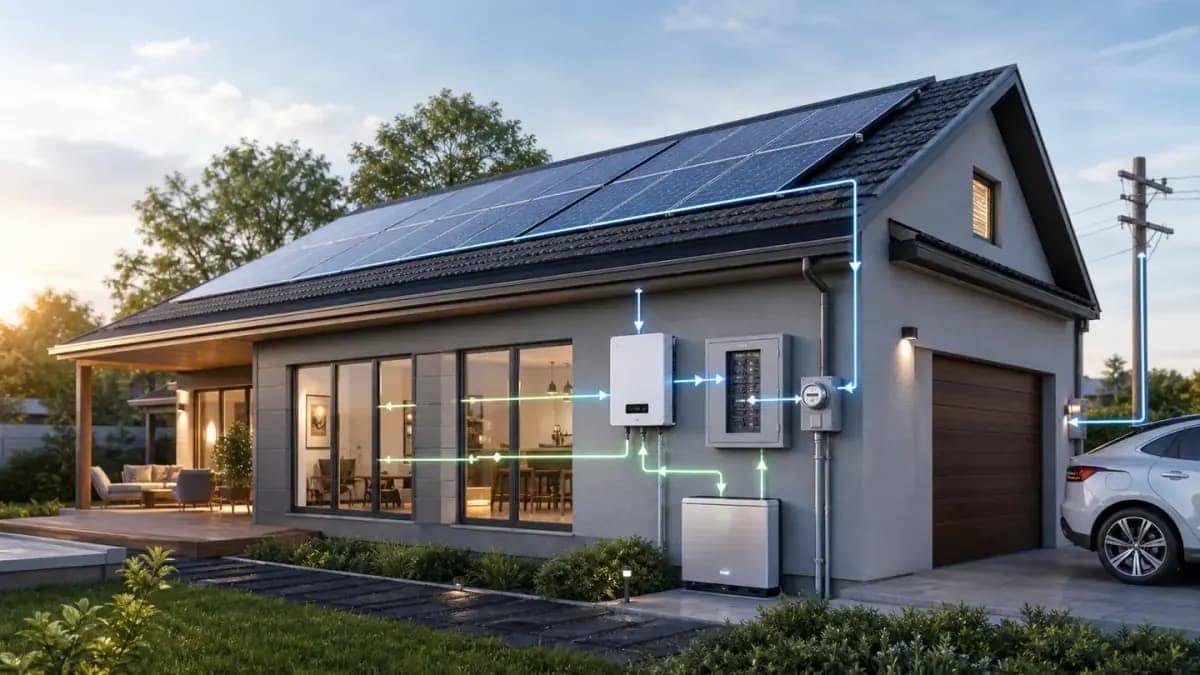
Solar PV converts sunlight directly into DC electricity through silicon cells. An inverter converts that DC into 240V AC your panel feeds back into the house. Modern modules are 400–450W each, so a 7 kW system is roughly 16–18 panels covering ~400 sqft of roof. Three things drive cost: per-Watt installed price (state labor + product class), system size (your usage divided by local sun yield), and optional add-ons (battery storage, premium inverters, ground mount). The federal 25D credit (30%) was terminated by OBBBA for property placed in service after 2025-12-31; 2026-forward economics depend on state programs and your utility’s export-compensation tariff.
Read the full guide 12-min read · how PV works · sizing · NEM successor tariffs · battery decision · 25-year economics
Frequently asked questions
How much does a residential solar system cost in 2026?
Median residential PV installs at $2.50–$4.50 per watt. A 7 kW system — typical for a 1,800 sqft home using 10,500 kWh/year — runs $17,500–$31,500 gross. State and utility incentives can knock $500–$4,000 off. The 30% federal 25D credit expired after 2025-12-31 — no federal credit applies to 2026-onward installs. Source: LBNL Tracking the Sun 2024, IRS 25D, EnergySage 2024–2025 marketplace data.
Is there a federal solar tax credit in 2026?
No. The Residential Clean Energy Credit (Section 25D) covered 30% of qualified solar PV, battery storage (≥3 kWh), and labor with no dollar cap — but OBBBA (signed July 2025) terminated the credit for property placed in service after 2025-12-31. Systems with a 2025 placed-in-service date still qualify for the 30% credit on the 2025 return. Source: IRS https://www.irs.gov/credits-deductions/residential-clean-energy-credit.
How long does payback take?
Typical residential solar pays back in 7–12 years, per NREL benchmark data, depending on your electricity rate, system size, and offset percentage. High-rate states like California, Massachusetts, and Hawaii see paybacks under 8 years. Low-rate states like Washington, Louisiana, and Idaho can take 12–15 years. Battery storage extends payback by 3–5 years on its own but enables resilience and self-consumption value not captured in simple payback math.
What size system do I need?
Multiply your annual usage (kWh on your utility bill, last 12 months) by 0.0008 to estimate kW. A 10,500 kWh/year U.S.-average home (per U.S. Energy Information Administration (EIA) data) needs about 7–9 kW depending on sun. Most installers size to offset 80–110% of annual usage. Going larger than ~110% is usually uneconomic under net-metering successor tariffs that pay export at sub-retail rates (CA NEM 3.0, MA SMART export, similar successor programs in NY and AZ).
Do I need a battery?
Not for bill savings — net-metering or its successor tariff handles that. You need a battery for backup power during outages or to time-shift solar into peak-rate evening hours. Under CA NEM 3.0 a battery dramatically improves economics because export rates are much lower than retail. Powerwall-class (~13.5 kWh) installs at $13,000–$19,000 in 2026, per NREL benchmark data. The federal 25D credit (30%) covered standalone batteries ≥3 kWh through 2025-12-31; OBBBA terminated it for 2026-onward installs.