
Panel upgrade
Electrical Panel Upgrade Cost Calculator
Plan-level cost for 100A→200A and 200A→320/400A service upgrades, subpanel adds, and NEC 750 load-management alternatives. Includes permit fees, state labor rates, and the panel-replacement vs. service-upgrade cost split.
Quick answer: a typical 100A→200A service upgrade runs $2,500–$5,000 installed; a panel-only replacement (same amperage) is $1,500–$3,000; a smart load-management device often replaces a $4,000 service upgrade for $500–$1,500.
Estimated installed cost
$3,100
Typical range $1,850 – $5,925 · 100A → 200A panel upgrade
Low
$1,850
Best case
Mid
Typical$3,100
Typical
High
$5,925
Worst case
Itemized cost breakdown
Click a row for math & sources| Line item | Low | Mid | High |
|---|---|---|---|
| $700 | $1,100 | $1,700 | |
State labor multiplier applied (CA). | $1,093 | $1,562 | $2,187 |
| $150 | $300 | $600 | |
Reflects installation difficulty, home type, and timing. | $0 | $148 | $1,449 |
| Total | $1,850 | $3,100 | $5,925 |
- Is this a panel replacement, service upgrade, or subpanel install?
- Is utility coordination and disconnect/reconnect included?
- Is the meter and main being replaced?
- Is grounding and bonding work included to current code?
- Will this support future EV charging and heat pump loads?
- Are smart load management devices an alternative to a full upgrade?
- Is permit and inspection included, and how long is the typical wait?
- What is the warranty on labor and the panel itself?
- Will any drywall repair, paint, or fire patching be needed?
- How long will my power be off during the upgrade?
Next step: how to vet a contractor & compare bids
What can change this price
- Estimates are planning ranges, not contractor quotes. Actual prices depend on your home, local labor rates, equipment, code requirements, utility rules, and contractor availability.
Actual prices depend on your home, local labor rates, equipment selection, code requirements, utility rules, and contractor availability. Estimates are planning ranges, not contractor quotes.
- BLS OEWS — Electricians (47-2111)— U.S. Bureau of Labor Statistics, reviewed 2026-05-01
See the single most-likely cost and the realistic range it falls in — not just a low/high band.
- ~30%Service mast, weatherhead, or meter base also replaced+$500–$2,500
- ~25%Grounding & bonding brought to current NEC (ground rods, water bond)+$200–$1,200
- ~15%Knob-and-tube or aluminum branch wiring found (older home)+$1,500–$6,000
- PossibleUtility disconnect / reconnect scheduling and permit fees+$150–$800
Surprise odds are approximate planning estimates, not measured rates; cost ranges are sourced where shown. How this works.
Method: each cost line is drawn from a triangular distribution and correlated by a shared market factor (~0.5), then sampled across 10,000 outcomes (a Monte Carlo simulation); the most-likely value and range emerge from the simulation, not the band. A planning simulation, not a quote.
New to electrical panels?
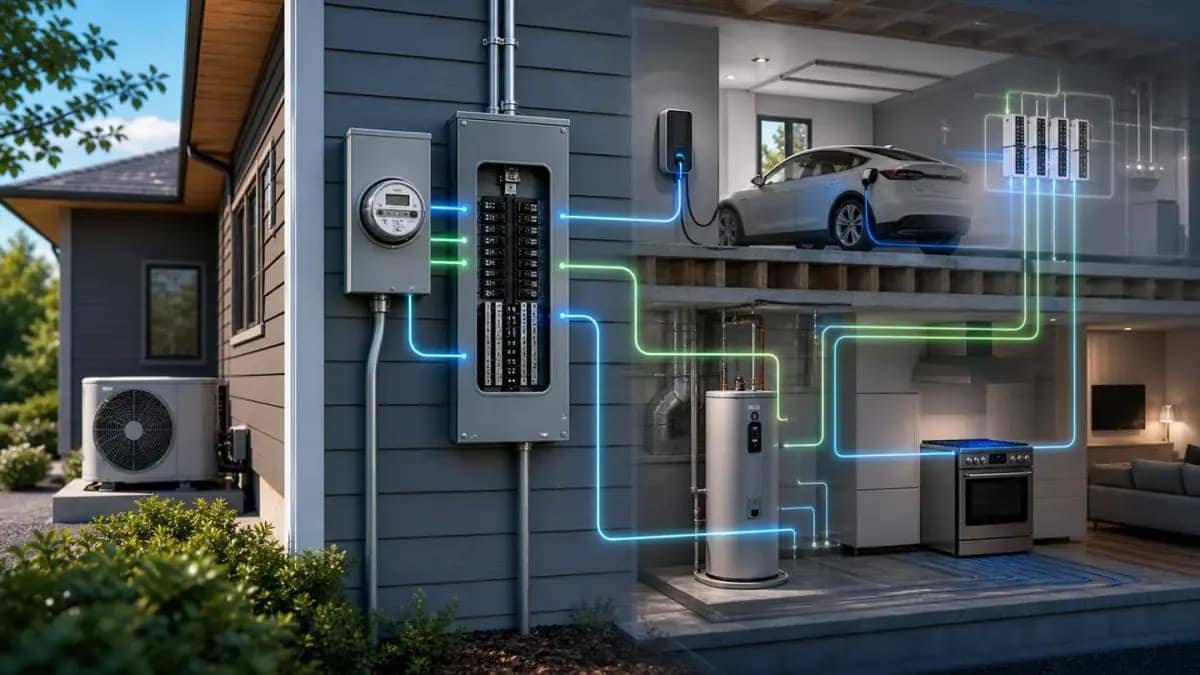
The panel is where the utility's incoming wires meet your home's circuits. Service size (60A / 100A / 200A / 320A) is the rating of the main breaker — not how many slots you have free. The three jobs people call "panel upgrade" are very different: a panel replacement swaps the box (e.g. for a recalled Federal Pacific / Zinsco), a service upgrade raises actual amperage and involves the utility, and a subpanel just adds breaker space. NEC 750 lets a $500–$1,500 load-management device often replace a $4,000 service upgrade.
Read the full guide 7-min read · anatomy · service-size table · NEC 220.83 · load management · recalled brands
Frequently asked questions
How much does it cost to upgrade from a 100A to 200A electrical panel?
Most 100A to 200A panel upgrades land between $1,800 and $4,500 installed, per NREL benchmark data and 2026 installer surveys. The big variables are the meter/main, utility coordination, grounding/bonding to current code, panel location, and whether the service drop must be replaced.
How long does a panel upgrade take?
A typical panel replacement is a one-day job, but power is often off for 4–8 hours during the cutover. Service upgrades involving meter/main replacement and utility coordination can stretch to 1–3 days because the utility has to schedule its part. Plan for the inconvenience.
Do I need a panel upgrade for an EV charger or heat pump?
Not always. A licensed electrician should run a load calculation per NEC 220.83. A 200A panel is usually sufficient. A 100A panel often works too, depending on existing loads. A 60A service almost always needs an upgrade.
Is smart load management an alternative to a panel upgrade?
Often, yes. NEC 750-listed energy management systems schedule large loads (EV charger, heat pump, dryer, induction range) so the home never exceeds existing service capacity. Total install cost is $500–$1,500 vs. $2,000–$4,500 for a full upgrade. Brands include Span, Lumin, DCC, and Wallbox load-share modes. NEC reference: https://www.nfpa.org/codes-and-standards/all-codes-and-standards/list-of-codes-and-standards/detail?code=70
When does a 200A panel become necessary?
Roughly: any combination of EV charging + heat pump + electric water heater + induction range will push a 100A panel into load-calculation gray zones. Not every home with that mix needs 200A — but most all-electric households end up with 200A or smart load management.
Are panel upgrades eligible for a federal tax credit?
Federal eligibility has changed. The One Big Beautiful Bill Act (OBBBA, signed July 4, 2025) terminated the Energy Efficient Home Improvement Credit (25C) for property placed in service after December 31, 2025. For panels installed in tax year 2025 (and only when paired with a qualified energy efficiency improvement such as a heat pump or HPWH), the credit covered up to $600 — 30% of cost, capped at $600 under 25C(c)(2)(B). For installs in 2026 or later, the federal 25C credit no longer applies. Verify current IRS guidance: https://www.irs.gov/credits-deductions/energy-efficient-home-improvement-credit. State and utility rebates may still be available — see /rebates/.
What is the difference between a panel replacement and a service upgrade?
A panel replacement swaps the breaker box itself — the wires from the meter stay. A service upgrade goes further and replaces the wires from the utility meter to your panel (and often the meter and main breaker). Going from 100A to 200A is usually a full service upgrade because the existing wires can’t carry 200A safely.
Will I need to replace the meter or service drop?
Often, yes. Going from 100A to 200A typically requires a meter base capable of 200A, and the wires from the utility transformer to your meter (the "service drop") may need replacement too. The utility usually does this part for free if you give them notice — but lead times can be weeks.
Should I plan for future 320/400A service?
Probably not, unless you’re building a fully-electric home with multiple EVs and a hot tub. 320/400A service is significantly more expensive (often double a 200A upgrade, per NREL benchmark data) and usually unnecessary even with full electrification.