
Air sealing
Air Sealing Cost Calculator
Cost + HVAC savings calculator for residential air sealing. Models DIY, professional targeted, deep sealing, and duct sealing options.
Quick answer: pro-targeted air sealing runs $800–$2,000 for a typical 1,800–3,000 sqft home. Deep sealing with blower-door verify $2,000–$6,500. Cuts HVAC bills 8–25%. Often paired with insulation; qualifies for DOE HOMES rebate where state programs are open.
Optional — auto-sets state
Installed cost · 2000 sqft · Massachusetts
$1,716
range $1,056 – $2,640
HVAC savings
$192/yr
8% of HVAC bill
Simple payback
8.9 yr
Climate zone: 5A
Cost breakdown
- Envelope sealing$1,716
- Total (mid)$1,716
Why air-seal first
Air leakage is invisible until measured. A leaky home (ACH50 ≥ 10) loses 30-50% more conditioned air than a sealed one (ACH50 ≤ 5). Sealing before insulation, heat pump, or window upgrades makes every downstream project work better — and often smaller.
Pair with a blower-door test (~$200-400 standalone) to measure pre/post.
Quote check — what to ask
- · Pre- and post-blower-door numbers (ACH50 or CFM50). Without this, the contractor can’t verify what was achieved.
- · BPI (Building Performance Institute) or RESNET certification — required for HOMES rebate eligibility.
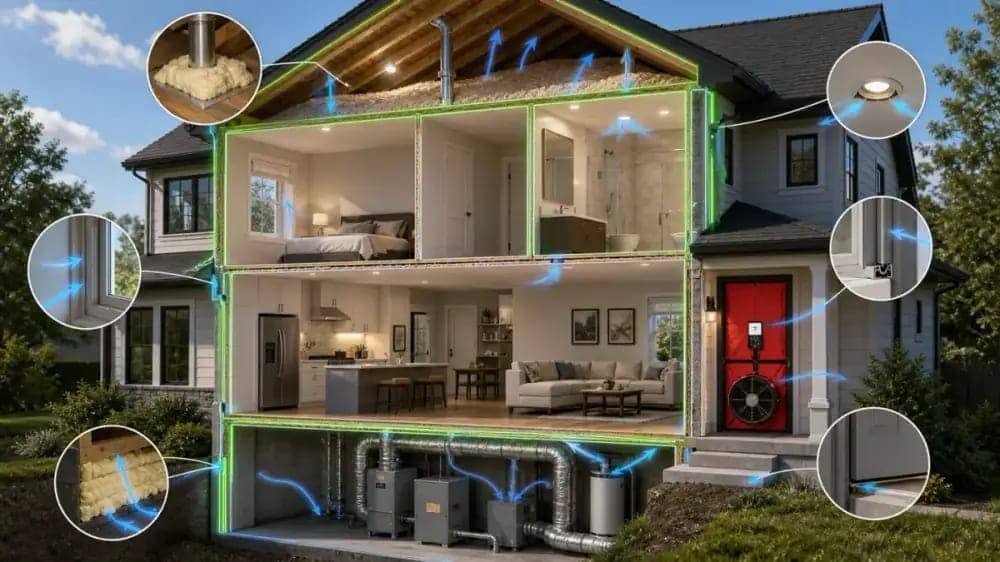
- · Specific areas addressed: attic plane, rim joists, recessed lights, plumbing penetrations, top plates, knee walls, basement-to-living-space transitions.
- · Combustion safety test (CO, draft, depressurization). If you have any combustion appliance and air-seal too tight, you can backdraft. Critical safety check.
- · Target ACH50 in writing. Mid-range goal: 3-5 ACH50 for retrofits; new construction targets 1-3.
- · Materials: low-VOC sealants, dense-pack cellulose for stuffed cavities, intumescent caulk at electrical penetrations.
- · Recessed light treatment — IC-rated cans or fixture replacement, not blanket-cover.
- · Photo documentation of inaccessible areas.
See the single most-likely cost and the realistic range it falls in — not just a low/high band.
- ~20%Combustion-safety failure - draft or venting fix before sealing+$200–$1,500
- PossibleKnob-and-tube remediation needed before sealing+$1,000–$5,000
Surprise odds are approximate planning estimates, not measured rates; cost ranges are sourced where shown. How this works.
Method: each cost line is drawn from a triangular distribution and correlated by a shared market factor (~0.5), then sampled across 10,000 outcomes (a Monte Carlo simulation); the most-likely value and range emerge from the simulation, not the band. A planning simulation, not a quote.
New to air sealing?
Air leakage costs you money in two ways: heated or cooled air leaves through gaps in your envelope, and unconditioned outside air comes in to replace it. Both increase HVAC runtime. A typical pre-1980 home leaks 30–50% more air than a sealed one. Professional air sealing addresses the major leakage paths (attic plane, rim joists, recessed lights, plumbing penetrations) with caulk, foam, and gaskets. The improvement is verified with a blower-door test that measures airflow at a standardized pressure.
Read the full guide 8-min read · ACH50 explained · blower-door tests · combustion safety · DIY vs pro
Frequently asked questions
How much does professional air sealing cost?
A typical professional targeted air-sealing job runs $800–$2,000 for a mid-size home (1800–3000 sqft) — covering attic plane, rim joists, recessed lights, plumbing penetrations, and other major leakage paths. Deep sealing with blower-door verification can reach $2,000–$6,500 for larger homes. DIY caulk-and-weatherstrip basics cost $80–$300 in materials but produce only modest improvement.
How much will air sealing save on my energy bills?
Typical pro-targeted air sealing cuts HVAC energy use 8-15% in a leaky home. Deep sealing pushes 15-25%. The math: a $1,500 sealing job on a home spending $2,400/yr on heating + cooling saves $200-400/yr — payback 4-8 years. The benefit compounds across the equipment lifespan and shrinks any future heat-pump install.
What is ACH50 and why does it matter?
ACH50 (Air Changes per Hour at 50 Pascals) is the standard blower-door test result. A leaky pre-1980 home is often 12-20 ACH50; a typical 1990s home is 8-12; a sealed retrofit hits 3-6; passive-house construction targets 0.6. Lower is tighter. The 2021 IECC requires new construction to hit ≤5 ACH50 in southern zones and ≤3 in northern zones. Retrofits typically can’t reach those targets but big gains are possible.
Should I air-seal before insulation?
Yes — order matters. Insulation alone, without air sealing, leaves convective heat loss intact (warm air leaking up and out through gaps). Air seal first to stop the convective losses, then add insulation for conductive resistance. Most professional energy audits will recommend the sequence as one combined project.
Can I air-seal too much?
Yes, in homes with combustion appliances (gas furnaces, gas water heaters, fireplaces). A too-tight envelope can backdraft combustion gases (including CO) into living spaces. A BPI- or RESNET-certified contractor will run combustion safety tests pre- and post-sealing. The fix is sealed-combustion appliances or mechanical ventilation (HRV/ERV), not "leave the house leaky on purpose."