
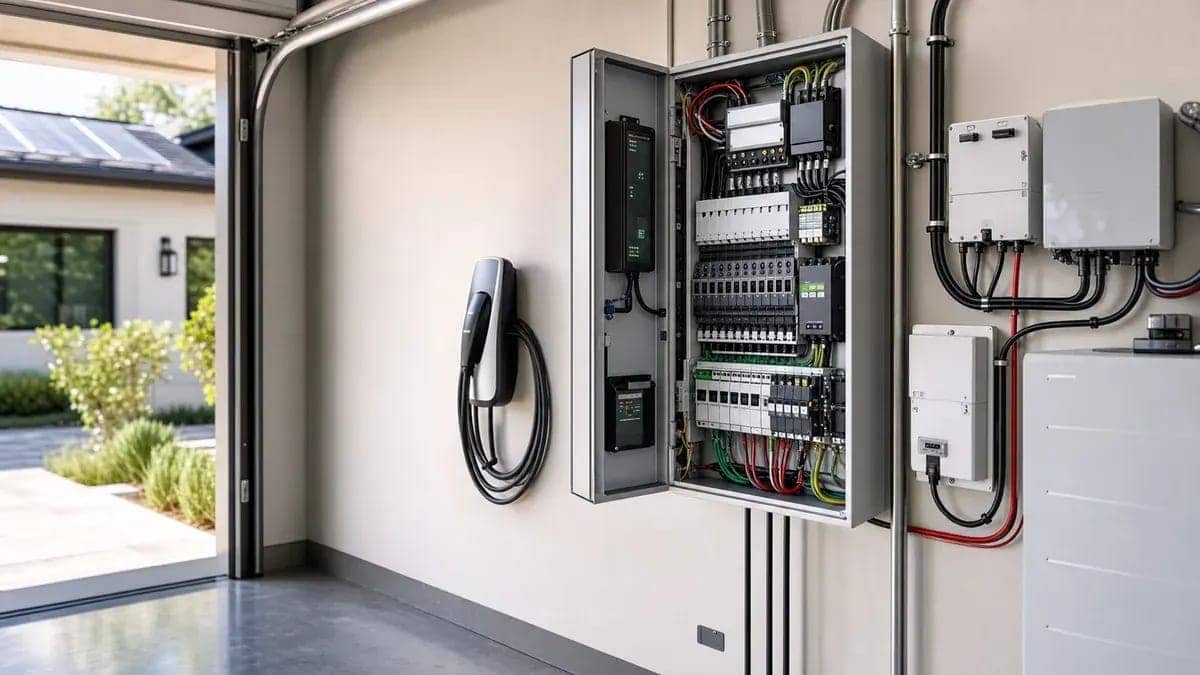
Smart electrical panel
Smart Electrical Panel Cost Calculator
Installed cost for smart electrical panels — Span Drive, Lumin, Schneider Square D Energy Center — compared with traditional 200A panel and avoided service-upgrade costs.
Quick answer: Span Drive $5,800–$9,000 installed. Schneider Square D Energy Center $5,200–$8,500. Lumin add-on $2,800–$4,800. Load-shed device only $1,000–$2,400. Smart panel often offsets a 100→200A service upgrade, narrowing the premium materially.
Optional — auto-sets state
Installed cost · Span Drive (full smart panel) · California
$8,376
range $6,256 – $11,690
Premium over traditional
$3,326
Traditional 200A: $5,050
Net after avoided upgrade
$326
Smart panel still costs more
When smart panel wins
- · You have a 100A or 125A service and want to add a heat pump + EV charger without upgrading.
- · You have solar + battery and want time-of-use load shifting.
- · You want app visibility into circuit-level consumption.
- · You're considering future backup-battery integration.
When traditional wins
- · You already have 200A+ service and aren't adding major loads.
- · You don't need circuit-level monitoring or app control.
- · You're not planning solar/battery integration.
- · Budget is the dominant constraint — traditional is $3,000–$4,000 cheaper.
See the single most-likely cost and the realistic range it falls in — not just a low/high band.
- ~25%Main service upgrade needed before the smart panel+$1,800–$4,500
- PossibleCircuit relabeling / remapping for monitoring+$150–$700
Surprise odds are approximate planning estimates, not measured rates; cost ranges are sourced where shown. How this works.
Method: each cost line is drawn from a triangular distribution and correlated by a shared market factor (~0.5), then sampled across 10,000 outcomes (a Monte Carlo simulation); the most-likely value and range emerge from the simulation, not the band. A planning simulation, not a quote.
New to smart panels?
A smart electrical panel adds software-controlled breakers, real-time per-circuit energy monitoring, and automated load management. The big win for electrification: dynamic load management means you can add a heat pump and EV charger on existing 100A service without a service upgrade. Span, Lumin, Schneider, and Eaton are the main brands; load-shed devices (DCC-9-USA, Wallbox EM112) address single-load scenarios at much lower cost.
Frequently asked questions
What is a smart electrical panel?
A panel with software-controlled breakers. Lets you monitor energy use per circuit, schedule loads, and automatically shed load during peaks. Three main approaches: full smart panel replacement (Span Drive, Schneider Square D Energy Center, Eaton), add-on smart load center (Lumin), or pure load-shedding device (DCC-9-USA, Wallbox EM112).
How much does a smart panel cost vs a traditional one?
Span Drive runs $5,800–$9,000 installed; Schneider Square D Energy Center $5,200–$8,500; Lumin add-on $2,800–$4,800. A traditional 200A panel installs for $2,400–$5,800. The smart-panel premium is typically $2,500–$4,500 — but it can offset a 100A→200A service upgrade ($1,500–$5,500), narrowing or eliminating the gap.
When does a smart panel make sense?
Three scenarios: (1) You have 100A or 125A service and want to add heat pump + EV charger without a full upgrade. (2) You have or plan solar + battery and want time-of-use load shifting. (3) You want circuit-level energy visibility. For homeowners with 200A+ and no major electrification plans, a traditional panel is usually the better economic choice.
Smart panel vs simple load-shedding device?
A load-shedding device (DCC-9-USA at $1,000–$2,400 installed) only manages one big load — usually the EV charger — pausing it when other appliances spike. A smart panel manages all circuits dynamically. If your only electrification project is an EV charger, the load-shed device is the right tool. If you’re doing heat pump + EV + HPWH, the smart panel pays back.