
Central AC
AC Replacement Cost Calculator
Installed-cost estimate for central air conditioning. Adjusts by tonnage, SEER2 efficiency tier, ductwork condition, optional furnace bundle, and state. Includes the 2025 R-32 / R-454B refrigerant-transition adder.
Quick answer: a 3-ton two-stage central AC installs for $8,000–$11,500 in 2026 with existing good ductwork. Variable-speed inverter systems run $11,000–$16,500. There is no federal tax credit for AC alone — if you’re replacing anything, run the heat pump calculator first.
Optional — auto-detects state
Selected size differs from recommended for 1800 sqft. Get a Manual J load calc before buying — oversized AC short-cycles and dehumidifies poorly.
Estimated installed cost · 3 ton two-stage · Texas
$11,264
range $8,707 – $14,441 installed
Consider a heat pump instead
A central air-source heat pump does cooling and heating with the same equipment. Estimated equivalent install: $17,264. Federal 25C credit ended 2025-12-31, but state and utility heat-pump rebates are widely available.
Open heat pump calculator →Cost breakdown
- Equipment (condenser + coil)$8,100
- Labor (install + commission)$2,356
- Refrigerant transition (A2L tooling)$400
- Ductwork$0
- Permit + disposal$408
Operating cost
- Climate zone
- 3A
- SEER2 selected
- 17.5
- Annual cooling kWh
- 5,369
- Annual cost
- $913
- Savings vs SEER 13 baseline
- $316/yr
Quote check — what to ask
- · Manual J load calculation (not a rule-of-thumb tonnage guess).
- · AHRI-matched system certificate (outdoor condenser + indoor coil pair).
- · SEER2, EER2, and HSPF2 numbers in writing — not SEER alone.
- · Refrigerant: R-32 or R-454B specifically (post-2025 units).
- · Line-set: new copper run vs flush-and-reuse of existing.
- · Equipment warranty (10-yr parts is standard) + labor warranty (1-10 yr varies by installer).
- · Commissioning report (charge weight, superheat/subcool, static pressure, airflow per ton).
- · Permit pulled (not "we don't need one — the city won't notice"). Improper installs void warranties.
See the single most-likely cost and the realistic range it falls in — not just a low/high band.
- ~30%Ductwork repair or resize (undersized return)+$800–$4,000
- ~25%Refrigerant line-set replacement / refrigerant changeover+$400–$1,500
- PossibleElectrical circuit or disconnect upgrade for the condenser+$300–$800
Surprise odds are approximate planning estimates, not measured rates; cost ranges are sourced where shown. How this works.
Method: each cost line is drawn from a triangular distribution and correlated by a shared market factor (~0.5), then sampled across 10,000 outcomes (a Monte Carlo simulation); the most-likely value and range emerge from the simulation, not the band. A planning simulation, not a quote.
New to central AC?
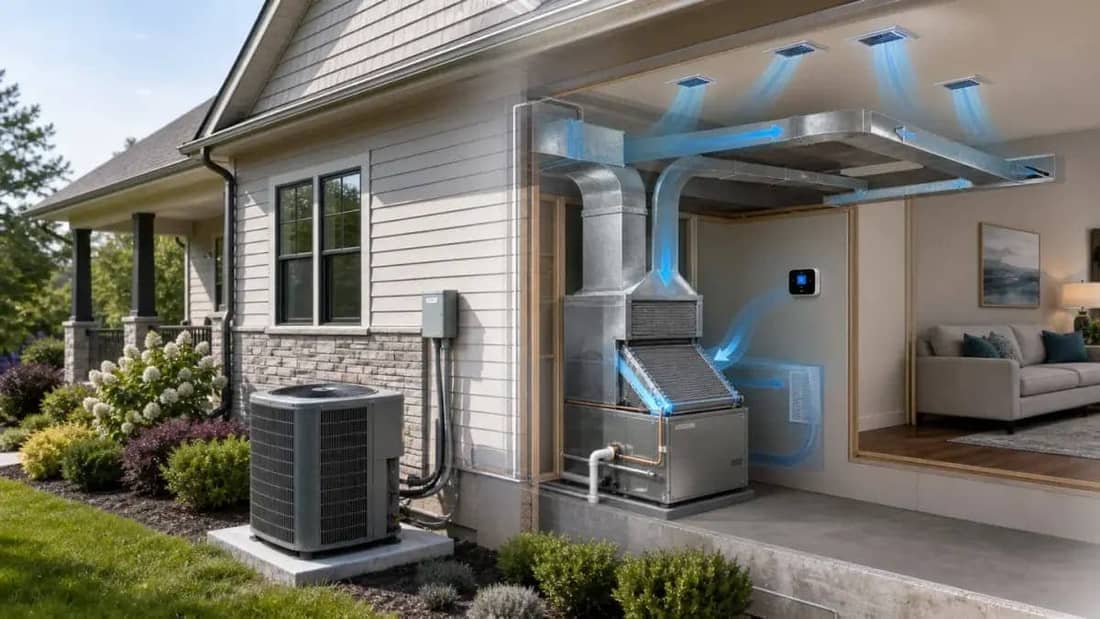
A central AC has two parts: an outdoor condenser/compressor and an indoor evaporator coil that sits on top of your furnace or air handler. A copper line-set carries refrigerant between them, and ductwork distributes cooled air through the house. Efficiency is rated in SEER2 (Seasonal Energy Efficiency Ratio, 2023 test procedure). Federal minimums for split-system central AC are 13.4 SEER2 in the North and 14.3 SEER2 in the South (units under 45,000 BTU/h). Variable-speed inverter systems reach 22-26 SEER2 and modulate continuously rather than cycling on and off — better dehumidification and 30-40% less electricity than a baseline single-stage unit.
Read the full guide 10-min read · SEER2 explained · R-32/R-454B refrigerant transition · sizing · heat pump alternative · contractor red flags
Frequently asked questions
How much does a new central AC cost installed in 2026?
A 3-ton single-stage (~15 SEER2) install typically runs $5,500–$8,500. Two-stage (~17.5 SEER2): $8,000–$11,500. Variable-speed inverter (~21 SEER2): $11,000–$16,500. Add $400–$1,500 for minor ductwork repair, $2,500–$7,500 for full duct replacement. The 2025 EPA R-410A phase-out means new units use R-32 or R-454B, adding $200–$700 in refrigerant-transition labor.
What is SEER2 and how is it different from SEER?
SEER2 is the updated efficiency rating that took effect 2023-01-01 under DOE's revised test procedure (Federal Register 87 FR 56500). It uses higher external static pressure than the old SEER test, producing more realistic real-world ratings. A SEER 16 rated under the old test is roughly SEER2 15.2. The federal minimum for split-system central AC is 13.4 SEER2 in the North and 14.3 SEER2 in the South (units under 45,000 BTU/h); variable-speed inverter systems reach 22-26 SEER2.
Should I replace AC or convert to a heat pump?
In most U.S. climates, a heat pump is the better choice if you're replacing anything. A central air-source heat pump does cooling and heating with the same equipment. The price premium is typically $1,500–$2,500 per ton over a comparable AC. Federal 25C credit ended 2025-12-31, but state and utility heat-pump rebates (e.g., Mass Save up to $8,500, NYSERDA, ComEd) are widely available. In states with cheap gas and cold winters, dual-fuel (heat pump + existing furnace) is often the sweet spot.
What is the refrigerant transition (R-32, R-454B)?
EPA's 2025 Significant New Alternatives Policy (SNAP) rule phases R-410A out of new residential AC and heat pump equipment manufactured after 2025-01-01. Manufacturers chose two replacements: Daikin (Goodman, Amana) uses R-32, while Carrier, Trane, Lennox, and York use R-454B. Both are A2L "mildly flammable" classifications requiring new installer training and tooling. Existing R-410A systems are fine to keep running and service; the rule only affects new equipment.
Is there a tax credit for replacing my AC?
No. The federal Energy Efficient Home Improvement Credit (25C) covered heat pumps and electric panels through 2025-12-31, but never air conditioning alone. The 25D Residential Clean Energy Credit covered solar PV, geothermal, and battery storage (it also expired 2025-12-31) — and never AC. Income-qualified households may still qualify for DOE Home Energy Rebates (HEEHRA) in states where the program is open, but again, only for heat pumps and other electrification measures, not standalone AC.