
Tankless water heater
Tankless Water Heater Cost Calculator
Installed-cost estimate for gas condensing, gas non-condensing, and electric tankless water heaters. State-aware labor multipliers, gas line work, panel considerations, and HPWH alternative comparison.
Quick answer: a gas condensing tankless installs for $4,500–$8,500. Cuts gas bills 15-25% vs a tank. Electric whole-home tankless is rarely practical — the 100-150A continuous draw usually triggers panel upgrade. If you’re going electric anyway, a heat pump water heater is the better answer.
Installed cost · California
$6,824
range $4,656 – $10,280
Annual operating cost
$316/yr
Annual savings vs tank baseline
+$168/yr
vs comparable tank water heater (negative = costs more)
Cost breakdown
- Equipment$2,200
- Install (labor + materials)$2,448
- Gas line work$1,224
- Tank removal + disposal$340
- Permit + inspection$612
Consider HPWH instead
A heat pump water heater (HPWH) installs for $2,500–$5,500 — comparable to gas tankless — and qualifies for income-tiered DOE Home Energy Rebates ($1,750 max in HEEHRA-open states). Operating cost is the lowest of any category. The catch: needs ~700 cu-ft of free air to breathe and a condensate drain. Best fit for unfinished basements and garages.
Open HPWH calculator →Quote check — what to ask
- · UEF (Uniform Energy Factor) — 0.95+ for condensing gas, 0.82-0.86 for non-condensing, 0.99 for electric.
- · Flow rate at design temperature rise (GPM @ 70°F rise in cold climates). 5+ GPM = 2-3 simultaneous showers.
- · Vent type — sealed Cat IV PVC for condensing (cheap, long runs OK); Cat III stainless for non-condensing (limited length).
- · Condensate handling for condensing units — drain to plumbing stack or sump, neutralizer cartridge required in some jurisdictions.
- · Water hardness — most tankless require < 7 grains/gallon or a softener; warranties void without descaling annually in hard-water areas.
- · Recirculation pump option if you have long pipe runs and want instant hot water.
- · Warranty (heat exchanger 12-15 yr, parts 5 yr, labor 1 yr typical).
See the single most-likely cost and the realistic range it falls in — not just a low/high band.
- ~30%Gas line upsize (tank-to-tankless conversion)+$500–$2,000
- ~25%Dedicated 240V circuit (electric) or new venting (gas)+$300–$1,500
- PossibleWater hardness - softener or filter for warranty+$800–$2,500
Surprise odds are approximate planning estimates, not measured rates; cost ranges are sourced where shown. How this works.
Method: each cost line is drawn from a triangular distribution and correlated by a shared market factor (~0.5), then sampled across 10,000 outcomes (a Monte Carlo simulation); the most-likely value and range emerge from the simulation, not the band. A planning simulation, not a quote.
New to tankless?
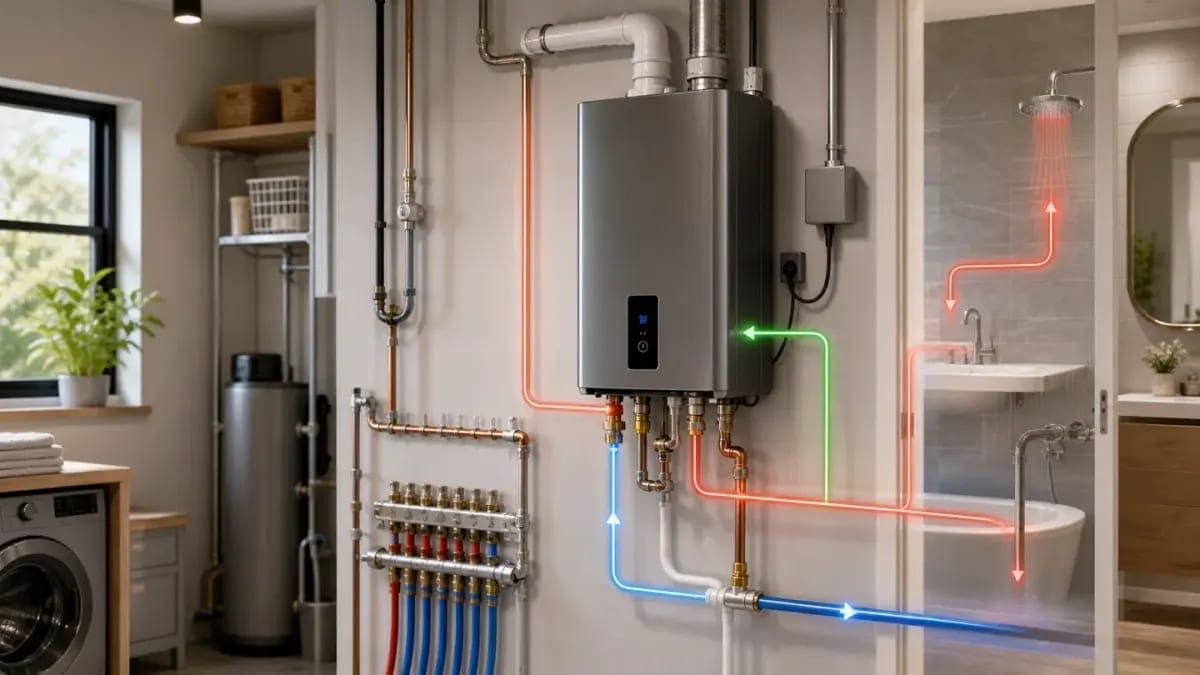
Tankless water heaters heat water on demand instead of maintaining a 40-50 gallon tank at 120°F continuously. They eliminate standby heat loss (the energy your tank radiates between uses) and deliver effectively unlimited hot water — limited only by flow rate at the supply temperature rise. Two flavors: gas (most common, 140,000-199,000 BTU/hr) and electric (whole-home 27-36 kW or point-of-use 18 kW). Gas units need a vent (PVC for condensing, stainless for non-condensing) and adequate gas line capacity. Electric whole-home is rarely practical due to amp draw.
Read the full guide 8-min read · condensing vs non-condensing · electric reality check · sizing · maintenance · vs HPWH
Frequently asked questions
How much does a tankless water heater cost installed?
Gas condensing tankless (95% AFUE Rinnai, Navien, Rheem, Bosch): $4,500–$8,500 installed. Gas non-condensing (82% AFUE): $3,000–$5,800 installed. Electric whole-home (27-36 kW Stiebel Eltron): $2,500–$5,500 hardware + likely panel upgrade ($1,500–$5,000) = $4,000–$10,500 total. Add $500–$1,500 if existing gas line needs upsizing.
Tankless vs tank vs HPWH — which to pick?
For natural-gas homes that already have a working gas line: condensing tankless is fine, $4,500–$8,500 installed, saves 15-25% on gas bills vs a standard tank. For homes going electric or wanting the lowest operating cost: heat pump water heater (HPWH) wins — $2,500–$5,500 installed, qualifies for HEEHRA rebate up to $1,750. Electric whole-home tankless is rarely advisable because the 100-150A continuous draw usually triggers a panel upgrade. Plain electric tank: cheap, simple, but high operating cost.
Why is electric tankless usually a bad idea?
A 36 kW whole-home electric tankless draws 150 amps at 240V. That's 75% of a 200A residential service by itself, leaving no headroom for AC or anything else. In cold-water states (where incoming water is 40-50°F), even 36 kW struggles to deliver 2 simultaneous showers in winter. The math: 36,000 W ÷ (4.18 J/g/°C × 40°C rise × 0.063 GPM/W) ≈ 3.4 GPM. A heat pump water heater stores hot water in a tank, so peak demand isn't a problem — and it uses 1/3 the electricity per gallon.
Does tankless save energy?
Yes, modestly. Tankless eliminates standby losses (the heat that escapes a tank between uses). DOE estimates 8-34% savings depending on usage pattern. Lower usage households see bigger percentage savings; high-usage households (4+ people, multiple showers daily) see less. ENERGY STAR-certified condensing units (Rinnai RUR, Navien NPE-2 series) deliver UEF 0.95+ vs 0.62 for a standard gas tank.
Is there a tax credit for tankless?
Federal 25C covered gas/propane storage and tankless water heaters at 30% up to $600 through 2025-12-31. OBBBA terminated 25C; not available for 2026 installs. HEEHRA (DOE Home Energy Rebates) covers heat pump water heaters but not gas tankless. Some utility programs offer $200–$500 rebates for ENERGY STAR tankless — check your local utility before assuming.