
Backup power
Home Generator Cost Calculator
Installed-cost estimate for portable, inverter, air-cooled standby, and liquid-cooled standby generators. Adjusts for size, fuel, transfer mechanism, and state labor.
Quick answer: a 22 kW whole-home air-cooled standby with full ATS installs for $11,000–$17,500. Portable + interlock kit: $2,000–$5,000. Compare to a 13.5 kWh battery ($13,000–$19,000) which qualified for 30% federal credit historically (expired 2025-12-31) and runs silently.
Optional — auto-detects state
Avg U.S. household experiences ~8 outage-hours/year; hurricane regions average 40-120 hours.
Installed cost · 18 kW · Florida
$12,156
range $7,973 – $18,252 installed
Annual operating
$300/yr
~24 hours runtime + service
Fuel rate
$2/hr
at 50% load, current fuel prices
Cost breakdown
- Generator equipment$5,100
- Transfer mechanism$2,450
- Install labor + materials$2,744
- Natural gas line extension$1,372
- Permit + inspection$490
Consider battery storage instead
A 13.5 kWh battery (Powerwall, Franklin) installs for $13,000–$19,000 — comparable to a 22 kW standby generator with whole-home ATS. The federal 25D credit (30%, including standalone batteries ≥3 kWh) was terminated by OBBBA for property placed in service after 2025-12-31, so it does not reduce 2026-forward battery installs; check state storage programs (CA SGIP, NY-Sun Storage, CT, MD). Battery is silent, doesn’t require fuel, runs from solar if you have it. Generator wins on sustained multi-day outages and unlimited capacity.
Open battery calculator →Quote check — what to ask
- · Permit pulled and inspected — non-negotiable.
- · Pad: poured concrete or pre-cast composite (Versa-Lift). Cheap installs use a gravel pad which fails NEC clearance requirements in many jurisdictions.
- · Fuel line sizing — natural gas needs adequate line pressure; many residential lines undersized for 22+ kW units.
- · Battery for control circuit — without it, the unit won’t start in winter.
- · ATS rating matches your service entrance (200A standard).
- · Bi-annual exercise schedule (most units self-test weekly).
- · Service contract: $200-450/year for standby units; check what’s included (oil + filter, valve adjustment, battery, transfer switch test).
See the single most-likely cost and the realistic range it falls in — not just a low/high band.
- ~30%Gas line upsize or a regulator for the unit+$500–$2,000
- PossibleTransfer switch or critical-loads subpanel+$500–$2,000
- PossibleConcrete pad, setback, and permit+$200–$1,200
Surprise odds are approximate planning estimates, not measured rates; cost ranges are sourced where shown. How this works.
Method: each cost line is drawn from a triangular distribution and correlated by a shared market factor (~0.5), then sampled across 10,000 outcomes (a Monte Carlo simulation); the most-likely value and range emerge from the simulation, not the band. A planning simulation, not a quote.
New to backup generators?
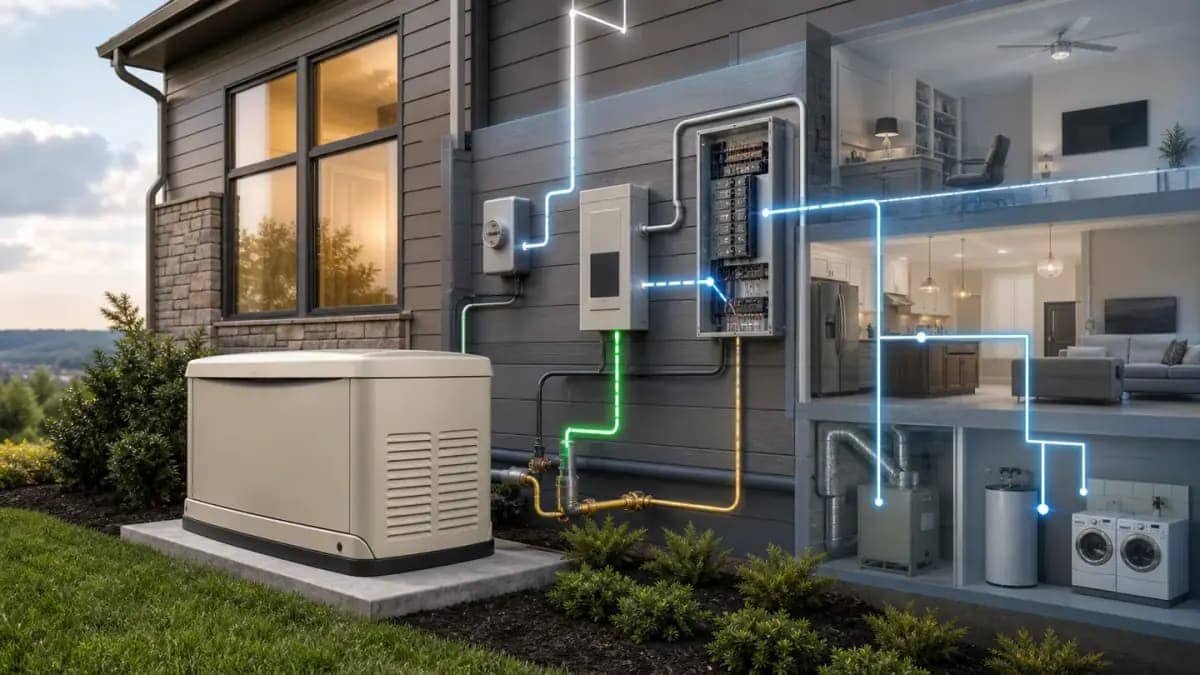
A backup generator converts mechanical energy (a gas engine) into electrical energy (an alternator) to power your house during a utility outage. Three classes: portable (wheels, refueled by hand, 5-14 kW), air-cooled standby (permanent install, 10-26 kW, the residential default), and liquid-cooled standby (heavy-duty, 14-48 kW, commercial-grade). The other half of any generator install is the transfer mechanism — interlock kit (cheap, manual) or automatic transfer switch (expensive, automatic). Backfeeding without one is illegal everywhere.
Read the full guide 9-min read · sizing · fuel choice · ATS vs interlock · NEC 702 · generator vs battery
Frequently asked questions
How much does a whole-home generator cost installed in 2026?
An 18-22 kW air-cooled standby generator (Generac Guardian, Kohler 20RCAL) installs for $9,000–$15,500 turnkey. That includes the generator ($5,100–$7,200), 200A whole-home automatic transfer switch ($1,500–$4,200), concrete pad + gas line + electrical wiring + permits. Liquid-cooled commercial-grade units (Generac Protector, Kohler 30RCL) run $20,000–$35,000+. Portable generators with an interlock kit: $1,500–$3,500.
Generator vs battery — which is right?
Battery wins for: silent operation, no fuel storage, integration with solar, short outages (<24 hours), daily TOU arbitrage in tariff-friendly states. Generator wins for: sustained multi-day outages (hurricane country), unlimited capacity if on natural gas, heavy loads like central AC. The federal 25D credit (30% standalone battery) expired for property placed in service after 2025-12-31 under OBBBA — both options now rely on state programs and operating value, not federal credit.
Natural gas, propane, or diesel?
Natural gas if your home has a gas line — unlimited runtime, no tank to fill, lowest fuel cost ($1–$2/hour at 50% load for 18-22 kW). Propane if you don't have natural gas — requires a 500-1000 gallon in-ground tank ($1,800–$4,200), 7-10 days of runtime per tank fill. Diesel for very large units (26 kW+) or commercial applications — most efficient but emissions and fuel storage are concerns. Gasoline for portable units only — limited tank capacity, fuel degrades in storage.
Do I need an automatic transfer switch?
For a standby generator: yes, by code (NEC 702.5). For a portable generator: an interlock kit + inlet box is the legal alternative (~$250–$700 vs $1,500–$4,200 for ATS). Interlock kits are mechanical breakers that physically prevent the main and generator breakers from being on simultaneously. Backfeeding without one is illegal in all 50 states because it sends 120V backward into the utility line and can kill repair crews.
How big should my generator be?
For critical-loads only (refrigerator, lights, internet, furnace blower, well pump): 7-10 kW. For whole-home with central AC selectively cycled: 18-22 kW. For whole-home running everything simultaneously including 4+ ton AC: 22-26 kW. Generac and Kohler offer free sizing tools. Most "whole-home" portable claims at 10-14 kW are misleading — they cannot start central AC without load shedding.