
Insulation & air-sealing
Insulation Cost Calculator
Installed-cost estimate for attic blown-in, wall drill-and-fill, air-sealing, and whole-envelope upgrades. R-value targets by climate zone, with DOE HOMES rebate where your state program is open.
Quick answer: attic + walls + air-sealing for a typical 1,800 sqft home runs $4,500–$8,500 installed. Income-qualified DOE HOMES rebate can subtract $2,000–$8,000 in open states. Cuts heating + cooling bills 15–30%. Do insulation before any heat-pump or panel work — it shrinks every downstream estimate.
Optional — auto-detects state
Estimated installed cost · 1800 sqft · Massachusetts
$14,890
range $10,058 – $21,674 gross
Net after rebate (mid)
$12,890
Range $9,058 – $17,674
Simple payback
28.7 yr
Saves ~$518/yr on HVAC
Cost breakdown
- Attic (blown cellulose)$4,752
- Walls (drill-and-fill)$8,554
- Air-sealing + blower door$1,584
Savings & rebates
- HVAC savings %
- 24%
- Climate zone
- 5A
- Annual HVAC cost
- $2,160
- DOE HOMES rebate
- −$2,000
25C tax credit for insulation ended 2025-12-31. DOE HOMES rebate availability varies by state — see /rebates/ for current state status. State + utility programs (Mass Save, NYSERDA, Energy Trust of Oregon) often layer on top.
Quote check — what to ask
- · Pre and post blower-door numbers (ACH50 or CFM50). Without this, the contractor can’t verify what was actually achieved.
- · Target R-value at completion (R-49 attic, R-13/15/20 wall by climate zone).
- · Air-sealing is line-itemed separately from insulation, not bundled vaguely.
- · Vapor retarder strategy appropriate to climate zone (more critical north of zone 4).
- · Recessed lights are IC-rated or replaced before blow-in covers them.
- · Attic baffles installed at every soffit vent to maintain ridge ventilation.
- · Knee-walls in finished attics and rim joists addressed.
- · Building Performance Institute (BPI) or RESNET certified contractor for HOMES rebate eligibility.
See the single most-likely cost and the realistic range it falls in — not just a low/high band.
- ~15%Knob-and-tube wiring remediated before blown-in insulation+$1,500–$6,000
- ~15%Vermiculite/asbestos or mold found in the attic+$800–$4,000
- PossibleRecessed-light IC covers, baffles, or venting fixes+$200–$1,200
Surprise odds are approximate planning estimates, not measured rates; cost ranges are sourced where shown. How this works.
Method: each cost line is drawn from a triangular distribution and correlated by a shared market factor (~0.5), then sampled across 10,000 outcomes (a Monte Carlo simulation); the most-likely value and range emerge from the simulation, not the band. A planning simulation, not a quote.
New to insulation upgrades?
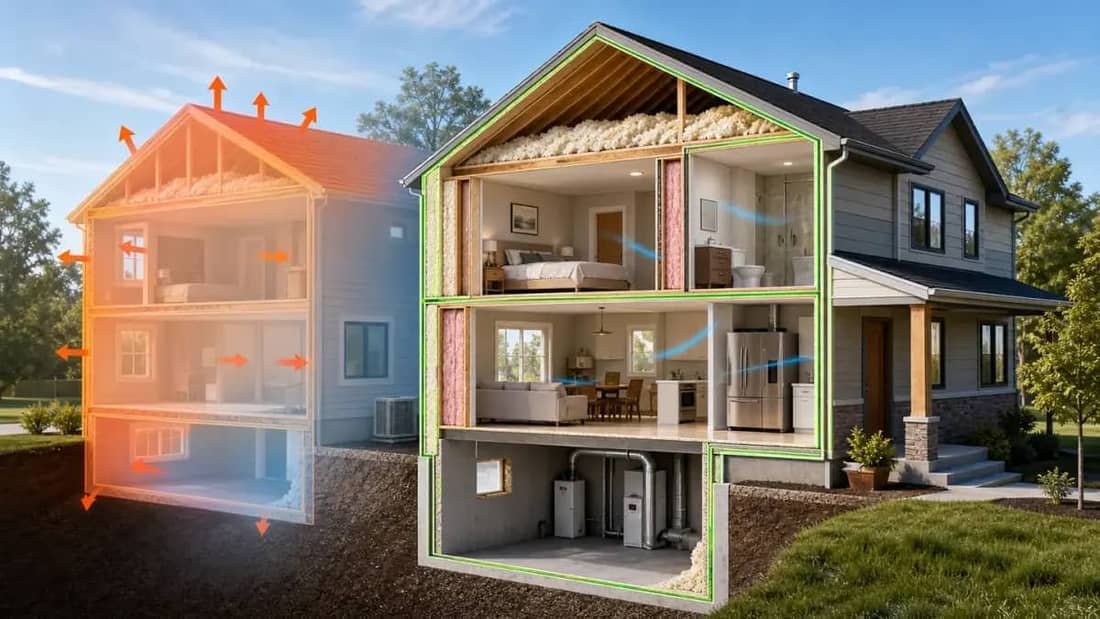
Insulation slows conductive heat transfer — measured in R-value (resistance per inch). Air-sealing stops convective heat transfer — drafts through gaps, holes, recessed light fixtures, plumbing penetrations. Both matter. A house with R-49 attic insulation and ACH50 = 12 (leaky) still bleeds heat fast. A house with R-30 attic and ACH50 = 3 (tight) holds heat much better. DOE/IECC targets attic R-49 to R-60 in most U.S. climates, with walls limited by stud depth (R-13 to R-21).
Read the full guide 9-min read · materials · attic vs walls vs basement · air sealing · blower door · DOE HOMES rebate
Frequently asked questions
How much does home insulation cost in 2026?
For a 1,800 sqft home in climate zone 5 (Northeast / Midwest), attic + walls + air-sealing typically runs $4,500–$8,500 installed. Attic-only is $2,700–$4,500. Whole-envelope (adding crawl/basement encapsulation) is $10,000–$22,000. Per-sqft attic pricing: blown cellulose $1.50–$2.50; blown fiberglass $1.25–$2.25; open-cell spray foam $3.50–$6.00; closed-cell $4.50–$8.50.
What R-value should I target?
DOE / 2021 IECC residential targets by climate zone: Zone 1 attic R-30 / wall R-13; Zone 2 R-49 / R-13; Zone 3 R-49 / R-15; Zones 4-5 R-49-60 / R-15-20; Zones 6-8 R-60 / R-20-21. Walls are limited by stud cavity depth (~R-15 for 2x4, ~R-21 for 2x6). Source: https://web.archive.org/web/20260101014129/https://www.energy.gov/energysaver/types-insulation and https://www.energycodes.gov/.
Is the 25C tax credit available for insulation in 2026?
No. The federal Energy Efficient Home Improvement Credit (25C) covered insulation and air-sealing at 30% of cost up to $1,200/year, but OBBBA (signed July 4, 2025) terminated the credit for property placed in service after 2025-12-31. Income-qualified households may still qualify for DOE Home Energy Rebates (HOMES) program — up to $4,000 (moderate income) or $8,000 (low income) for projects with 35%+ modeled energy savings. Status varies by state; check /rebates/.
Why do insulation first?
A tighter envelope shrinks every downstream HVAC estimate. If you do insulation first, the heat pump quote may drop a half-ton (~$1,500 less), the panel may not need an upgrade ($1,500-5,000 saved), and your operating bills are lower for the next 20+ years. The right sequence for whole-home electrification is: insulation + air-sealing → heat pump → EV charger → HPWH → induction.
Cellulose, fiberglass, or spray foam?
Blown-in cellulose is the most cost-effective attic upgrade — recycled paper treated with fire retardant, R-3.7 per inch, settles less than fiberglass, fills gaps around joists. Blown-in fiberglass is slightly cheaper but doesn't pack as well. Spray foam (open or closed cell) is the most expensive but air-seals as it insulates, valuable for cathedral ceilings, knee-walls, and rim joists. Most homes do best with cellulose attic + foam at rim joists + drill-and-fill walls.