
Off-grid solar
Off-Grid Solar System Cost Calculator
Cost calculator for off-grid solar + battery systems sized by daily kWh load. From weekend cabin to full-electric homestead, plus grid-tied with whole-home backup.
Quick answer: weekend cabin $10,000–$23,000. Full-time cabin $23,000–$51,000. Modest homestead $40,000–$82,000. Full-electric homestead $66,000–$148,000. The 25D credit expired Dec 31 2025.
Optional — auto-sets state
Installed cost · Full-time cabin (small home) · Montana
$35,200
range $23,000 – $51,200
PV array
4 kW
$11,000
Battery
20 kWh
$15,000
Inverter + install
$9,200
See the single most-likely cost and the realistic range it falls in — not just a low/high band.
- PossibleBattery bank wiring or enclosure upgrade+$800–$3,500
- PossibleGround-mount foundation or extra racking+$1,000–$4,000
- PossibleBackup generator / auto-start integration+$1,500–$6,000
Surprise odds are approximate planning estimates, not measured rates; cost ranges are sourced where shown. How this works.
Method: each cost line is drawn from a triangular distribution and correlated by a shared market factor (~0.5), then sampled across 10,000 outcomes (a Monte Carlo simulation); the most-likely value and range emerge from the simulation, not the band. A planning simulation, not a quote.
New to off-grid solar?
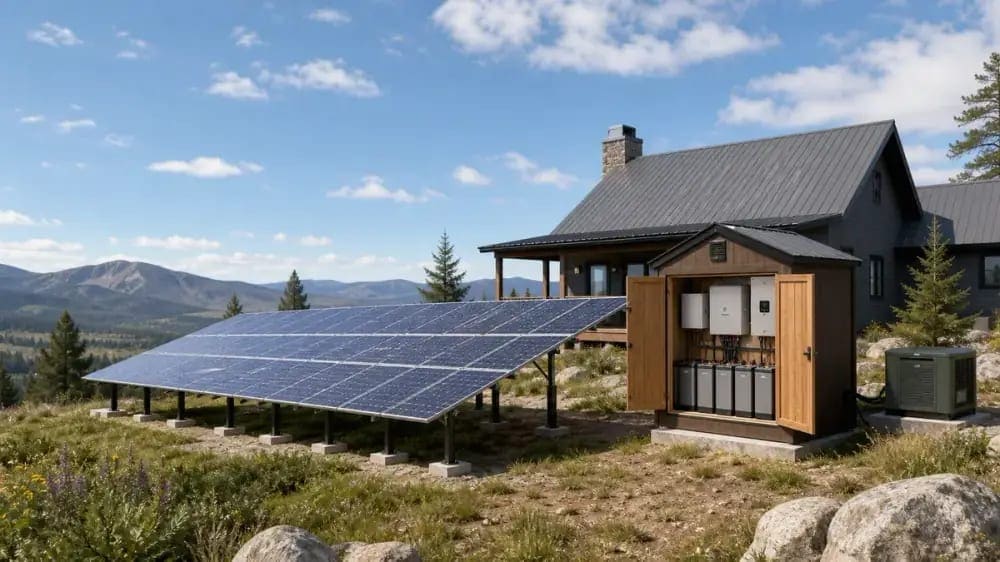
Off-grid systems differ from grid-tied solar in three ways: bigger battery (you can’t export to the grid), beefier inverter (must run all loads simultaneously without grid support), and backup heat source (you can’t run a heat pump at design temperature on solar alone in winter). Most off-grid setups include a small wood stove or propane heat for the coldest weeks of the year.
Frequently asked questions
How much does an off-grid solar system cost?
Weekend cabin basic (5 kWh/day): $10,000–$23,000. Full-time cabin (15 kWh/day): $23,000–$51,000. Modest homestead (25 kWh/day, gas heat): $40,000–$82,000. Full-electric homestead (40 kWh/day): $66,000–$148,000. Grid-tied with whole-home backup: $48,000–$107,000.
How big a battery do I need?
Industry standard: 2 days of average daily use. So a 15 kWh/day household needs ~30 kWh of usable battery storage (typically 40-60 kWh nominal). Lithium-iron-phosphate (LFP) chemistry — Tesla Powerwall, Enphase IQ Battery, Sol-Ark — is the modern standard for off-grid; replaces lead-acid which needed 4-5× nominal capacity.
Is the 25D credit available for off-grid solar in 2026?
No. The 30% Residential Clean Energy Credit (25D) for solar + battery expired Dec 31 2025 (OBBBA). 2026+ off-grid installs no longer have the federal subsidy. State programs vary — Vermont, Maine, and New York still offer modest credits.
Off-grid vs grid-tied with backup — which makes sense?
Off-grid only makes sense if you literally cannot connect to the grid (location), the grid extension cost exceeds the off-grid system cost, or you have a strong philosophical preference. For 99% of homeowners, grid-tied solar + battery with off-grid capability (Sol-Ark, Outback Skybox) is the better engineering — you get backup during outages but use the grid as a free, infinite battery the rest of the time.