
Induction stove
Induction Stove Cost Calculator
Plan-level installed cost for an induction range or cooktop, including a new 240V circuit, gas line cap, and a starter cookware allowance.
Quick answer: a basic 30-inch induction range installs for $1,500–$3,500. Coming from gas adds $400–$1,300 for a new 240V circuit and $150–$450 for a licensed-plumber gas-line cap. Income-qualified DOE rebate up to $840 in open states. Federal 25C does not apply.
Estimated installed cost
$3,300
Typical range $1,750 – $6,250 · 30-inch induction range (basic)
Low
$1,750
Best case
Mid
Typical$3,300
Typical
High
$6,250
Worst case
Itemized cost breakdown
Click a row for math & sources| Line item | Low | Mid | High |
|---|---|---|---|
| $850 | $1,300 | $2,000 | |
State labor multiplier applied (CA). | $284 | $568 | $852 |
| $50 | $100 | $200 | |
Reflects installation difficulty, home type, and timing. | $0 | $98 | $986 |
| $400 | $750 | $1,300 | |
Required when removing a gas range; varies by jurisdiction and access. | $150 | $275 | $450 |
Most stainless and cast-iron pans work; fully aluminum and copper do not. | $75 | $200 | $450 |
| Total | $1,750 | $3,300 | $6,250 |
Monthly energy impact
~Neutral$1/ mo
Bills change very little — between -$3 and $1 per month either way.
Panel upgrade likelihood
Low risk100A typically supports induction range with load calculation
- Is a new 240V circuit required, or can I use existing wiring?
- Is the 240V outlet (NEMA 14-50 or similar) included?
- Will my panel support the new induction load?
- Is gas line capping by a licensed plumber included if I'm switching from gas?
- Is the range, cooktop, or only the wiring included in the quote?
- Does the quote include permit and inspection?
- Is there a separate cookware allowance for induction-compatible pans?
- What is the labor warranty?
- Are any countertop modifications needed?
- Is removal and disposal of the old range included?
Next step: how to vet a contractor & compare bids
What can change this price
- Estimates are planning ranges, not contractor quotes. Actual prices depend on your home, local labor rates, equipment, code requirements, utility rules, and contractor availability.
Actual prices depend on your home, local labor rates, equipment selection, code requirements, utility rules, and contractor availability. Estimates are planning ranges, not contractor quotes.
- ENERGY STAR Cooktop & Range Resources— ENERGY STAR, reviewed 2026-05-01
- EIA Electricity Retail Sales (state-level)— U.S. Energy Information Administration, reviewed 2026-04-01
- BLS OEWS — Electricians (47-2111)— U.S. Bureau of Labor Statistics, reviewed 2026-05-01
See the single most-likely cost and the realistic range it falls in — not just a low/high band.
- ~45%New 240V/40-50A circuit run to the kitchen (gas-to-induction)+$400–$1,800
- ~30%Gas line capped by a licensed plumber+$150–$600
- PossiblePanel has no open slots - subpanel or load management+$500–$2,000
- PossibleCountertop or cabinet cutout modified for a larger unit+$150–$700
Surprise odds are approximate planning estimates, not measured rates; cost ranges are sourced where shown. How this works.
Method: each cost line is drawn from a triangular distribution and correlated by a shared market factor (~0.5), then sampled across 10,000 outcomes (a Monte Carlo simulation); the most-likely value and range emerge from the simulation, not the band. A planning simulation, not a quote.
New to induction cooking?
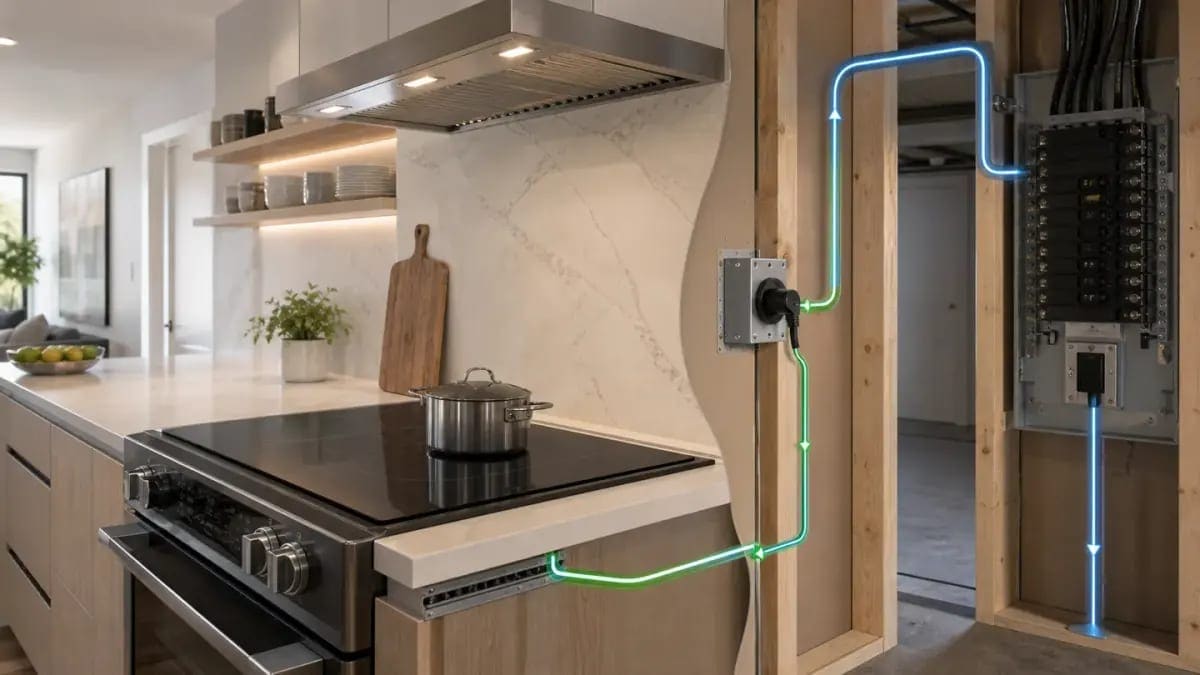
Induction heats the pan, not the burner: an electromagnetic field induces eddy currents in any ferromagnetic cookware (cast iron, magnetic stainless, carbon steel). The cooktop glass stays cool except where the pan transfers heat back. 85% efficient at the pan vs. 40% for gas; water boils in half the time. Quick test for cookware: if a fridge magnet sticks to the pan bottom, it works. A range needs a 240V/40–50A circuit; if you are coming from gas you also need a licensed plumber to cap the gas line.
Read the full guide 6-min read
Frequently asked questions
How much does it cost to switch from gas to induction?
A basic 30-inch induction range installs for $1,500 to $3,500, per NREL benchmark data and 2026 installer surveys. Coming from gas adds $400 to $1,300 for a new 240V circuit and $150 to $450 to cap the gas line. A starter induction cookware allowance adds $75 to $450 if your existing pots arent ferromagnetic.
Do I need a 240V outlet for an induction range?
Yes, full-size induction ranges require a dedicated 240V/40-50A circuit (typically NEMA 14-50), just like a traditional electric range. Plug-in induction cooktops can run on standard 120V outlets but are limited to about 1,800W total power.
Will my pots and pans work?
Most stainless steel and cast-iron pans work. Aluminum and copper-only pans do not. The magnet test is the quickest check: if a magnet sticks firmly to the bottom of the pan, it is induction-compatible.
Does the federal 25C credit cover induction stoves?
No, ranges and cooktops are not 25C-eligible and 25C ended Dec 31, 2025 under OBBBA. Income-qualified households may qualify for a DOE Home Energy Rebate (HEEHRA) of up to $840 for an electric stove/cooktop/range, administered by states. Track program status at https://www.energy.gov/scep/home-energy-rebates-programs.
What are the indoor-air-quality benefits of induction?
No combustion in the kitchen means no NO2, CO, or formaldehyde from cooking, and no methane leakage from the gas connection. The Stanford and CARB studies found gas stoves elevate household NO2 to levels EPA would not allow outdoors. For households with asthma or young children this is one of the bigger health-driven motivators to switch.
Range vs cooktop vs portable: which one fits?
A full-size range (30/36 inch, $1,500–$6,500 installed, per NREL benchmark data) is the all-in-one swap. A cooktop ($800–$2,400) plus a separate wall oven works for renovations. A portable single-burner unit ($75–$250) is the gateway drug: borrow one for a week before committing. Sizing-wise, 30 inch is the US default; 36 inch suits serious home cooks.
Is induction safe around pacemakers or kids?
For pacemakers, manufacturers (Medtronic, Boston Scientific) recommend at least 24 inches between the device and an active induction burner, the same rule as for arc-welding equipment. Most patients can cook normally; check with your cardiologist. For kids, the cooktop glass only heats where the pan transfers heat back, so it cools faster than a gas burner. The pan and any spilled liquid stay hot, so normal stovetop precautions apply.
What brand should I look at?
Yale Appliance 2026 service-call data ranks LG, GE Profile, and Cafe as the most reliable induction-range brands. Frigidaire ($1,099) and GE Profile ($1,499) are the value picks; Bosch 500 ($2,099) and Cafe ($3,000+) are the mid-range; Wolf, Miele, and Thermador are the premium tier. https://blog.yaleappliance.com/most-reliable-induction-ranges
Do I still need a range hood?
Yes. Even without combustion gases, cooking releases steam, smoke, oil aerosols, and PM2.5 particulates. ASHRAE 62.2 recommends at least 100 CFM exhaust to outside, captured under a hood that covers the full cooktop. A recirculating (ductless) hood is a poor substitute when a vented run is feasible.
What questions should I ask the contractor?
See the contractor checklist next to the calculator result above. It covers panel capacity for the new 240V circuit, gas-line cap by a licensed plumber, range-hood CFM and venting, anti-tip bracket, and cookware compatibility before delivery.