
Heat pump water heater
Heat Pump Water Heater Cost Calculator
Estimate planning-level installed cost for 120V plug-in, 240V hybrid, and split-system heat pump water heaters. Rebate-aware with panel and condensate planning.
Quick answer: a 240V hybrid HPWH (50 gal) is typically $2,200–$4,200 installed. A 120V plug-in version skips the electrical work for $1,700–$3,400. Income-qualified DOE Home Energy Rebate caps at $1,750 in states where the program is open. Federal 25C expired Dec 31 2025.
Estimated installed cost
$3,725
Typical range $2,275 – $6,875 · 240V hybrid HPWH (50 gal)
Low
$2,275
Best case
Mid
Typical$3,725
Typical
High
$6,875
Worst case
Itemized cost breakdown
Click a row for math & sources| Line item | Low | Mid | High |
|---|---|---|---|
| $1,500 | $2,000 | $2,800 | |
State labor multiplier applied (CA). | $674 | $1,180 | $1,855 |
| $75 | $175 | $350 | |
Reflects installation difficulty, home type, and timing. | $0 | $168 | $1,616 |
| $140 | $200 | $260 | |
| Total | $2,275 | $3,725 | $6,875 |
Possible additional incentives
These are not subtracted from the net cost above because eligibility isn't confirmed for your address yet.
- TECH Clean California - HPWHPotentialStateRebate
Funding fully reserved — the administrator is not accepting new reservations. Shown for context; not subtracted from your net cost above.
up to −$1,000Source ↗
Monthly energy impact
~Neutral$0/ mo
Bills change very little — between -$2 and $3 per month either way.
Panel upgrade likelihood
Low risk100A typically supports HPWH addition
- Is a 120V plug-in or 240V hybrid model being quoted?
- Is condensate drain work included (drain pan, pump, or gravity routing)?
- Is the install location large enough for proper airflow (typically ≥700 cu ft)?
- Is sound rating (dB) acceptable for the location?
- Is old water heater removal and disposal included?
- Which rebates require pre-approval, and have they been applied for?
- Is the 240V circuit, outlet, or breaker work included if needed?
- Are permits and inspection included?
- Will the cold-air output affect any nearby living space?
- What is the warranty on tank, compressor, and labor?
Next step: how to vet a contractor & compare bids
What can change this price
- Estimates are planning ranges, not contractor quotes. Actual prices depend on your home, local labor rates, equipment, code requirements, utility rules, and contractor availability.
- Some incentives are surfaced as "potential" because eligibility is not yet confirmed; they are not subtracted from your net cost.
Actual prices depend on your home, local labor rates, equipment selection, code requirements, utility rules, and contractor availability. Estimates are planning ranges, not contractor quotes.
- DOE Energy Saver — Heat Pump Water Heaters— U.S. Department of Energy, reviewed 2026-07-04
- EIA Electricity Retail Sales (state-level)— U.S. Energy Information Administration, reviewed 2026-04-01
- BLS OEWS — Electricians (47-2111)— U.S. Bureau of Labor Statistics, reviewed 2026-05-01
See the single most-likely cost and the realistic range it falls in — not just a low/high band.
- ~35%Dedicated 240V circuit run (gas-to-electric conversion)+$300–$1,200
- PossibleCondensate drain or pump routing in a tight space+$150–$700
- PossibleDucting kit or louvered door for a small mechanical closet+$200–$900
Surprise odds are approximate planning estimates, not measured rates; cost ranges are sourced where shown. How this works.
Method: each cost line is drawn from a triangular distribution and correlated by a shared market factor (~0.5), then sampled across 10,000 outcomes (a Monte Carlo simulation); the most-likely value and range emerge from the simulation, not the band. A planning simulation, not a quote.
New to heat pump water heaters?
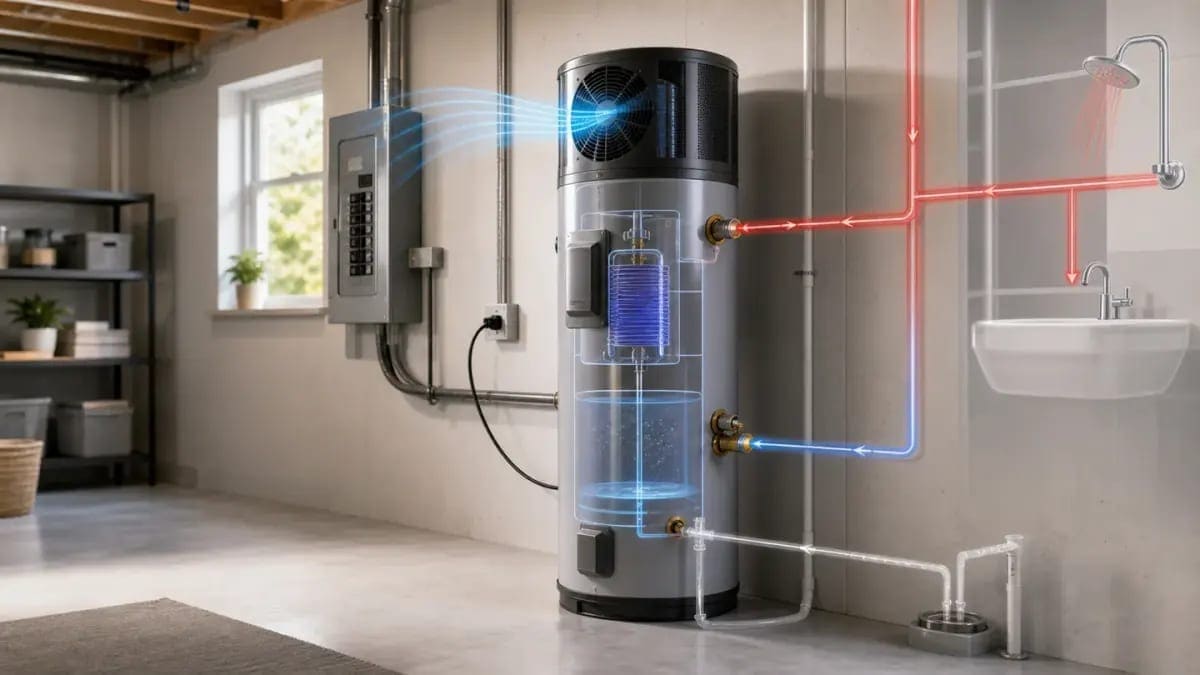
An HPWH is a tank water heater with a refrigeration cycle on top: it moves heat from the surrounding air into the water instead of generating it directly. UEF 3.0–4.0 vs. 0.95 for a standard electric resistance tank means meaningful operating-cost savings. Three form factors: 120V plug-in (no electrical work needed), 240V hybrid (the mainstream), or split-system (compressor outside). Needs about 700 cu-ft of free air to breathe and a condensate drain. 10–15 year service life.
Read the full guide 7-min read
Frequently asked questions
How much does a heat pump water heater cost installed?
A standard 240V hybrid HPWH (50 gal) is typically $2,200 to $4,200 installed, per NREL benchmark data and 2026 installer surveys. 120V plug-in models are $1,700 to $3,400. 80-gallon hybrids run $2,700 to $5,200, and split-system HPWHs (Sanden / Daikin Altherma class) are $5,500 to $12,000. Removal of the old water heater, condensate routing, and any new electrical circuit can shift the total $200 to $700.
Should I buy a 120V plug-in or 240V hybrid HPWH?
120V plug-in HPWHs avoid new circuit work and are great for older panels or condos. 240V hybrids deliver faster recovery and slightly better efficiency. Pick the 120V model if your panel is full or budget is tight; pick the 240V hybrid for a household of 4+ people.
Does an HPWH need a big room?
Manufacturer rules of thumb range from about 450 to 1,000 cubic feet of free air, depending on model. Roughly 700 cu-ft is a common middle-ground figure for a typical 50-gallon hybrid. Tight closets need a louvered door, ducted intake/exhaust, or a split-system unit. See DOE Energy Saver: https://web.archive.org/web/20260101014727/https://www.energy.gov/energysaver/heat-pump-water-heaters and your model install manual (Rheem, AOSmith, Bradford White, SanCO2).
What rebates are available for heat pump water heaters?
No federal credits for 2026 installs: the 25C credit expired Dec 31, 2025 under OBBBA. DOE Home Energy Rebates (HEEHRA) provide up to $1,750 for HPWH for income-qualified households where states have launched (rollout uneven). State and utility rebates often add $400 to $1,000 more. See /rebates/ or DSIRE: https://www.dsireusa.org/. For historical 2025 installs, 25C covered 30% up to $2,000 (cap shared with heat pumps).
Will a heat pump water heater make my house cold?
It removes heat from the surrounding air to heat water. In a garage or basement that is usually a benefit (it dehumidifies, too). In a small interior closet without ducting, it can be a problem. Plan the location and confirm at least 700 cu-ft of free air, per the U.S. Department of Energy (DOE), or use a ducted-intake kit.
How noisy is a heat pump water heater?
Roughly 45-55 dB(A) at one meter, per the U.S. Department of Energy (DOE) and manufacturer specs, depending on model and fan speed setting. Comparable to a quiet refrigerator. Rheem ProTerra is the typical benchmark at 49 dB(A). Locate it away from sleeping areas or use the manufacturer hybrid mode that biases toward the resistance element overnight.
What is the recovery rate vs a gas tank?
A 50-gal hybrid HPWH recovers about 18-25 gallons of hot water per hour in heat-pump-only mode, per the U.S. Department of Energy (DOE), vs. 35-40 gph for a typical gas tank. Switching to hybrid/electric resistance mode brings recovery to about 30 gph. For households of 5+ or back-to-back showers, size up to 80 gallons or pair with a recirculation loop.
How long does a heat pump water heater last?
Tank life is 10-15 years for the hybrid models; compressor warranties from major brands run 6-10 years. Replace the anode rod every 3-5 years to extend tank life. Field reliability data from NEEA and Bonneville Power Administration field studies is good, with most replacements driven by anode neglect rather than compressor failure.
Do I need a condensate drain?
Yes. The HPWH produces about 1-2 gallons of condensate per day from dehumidifying the surrounding air, according to the U.S. Department of Energy (DOE). Route to a floor drain, condensate pump, or laundry tub. Skipping the drain voids most rebates and creates a slow water leak. Plan a 3/4-inch PVC line during install.
What questions should I ask the contractor?
See the contractor checklist next to the calculator result above. It covers free-air-volume confirmation, condensate routing, electrical circuit, anti-vibration pad, anode access, rebate paperwork, and the cold-air-output mitigation plan.