
Smart thermostat
Smart Thermostat Cost Calculator
Installed-cost estimate for Nest, Ecobee Premium, Honeywell T9, and basic Wi-Fi thermostats. DIY vs pro install, C-wire risk, utility rebates, and HVAC-savings payback.
Quick answer: $90–$280 hardware + $0 (DIY) or $150–$400 (pro). Most homes save 10% on HVAC, payback in 1-2 years. If your system lacks a C-wire add $100–$350 for an electrician.
Optional — auto-detects state
Sum your heating + cooling utility bills for the last 12 months. National average ~$1,500.
Installed cost · California
$264
net after ~$100 utility rebate · $364 gross
Annual HVAC savings
$150/yr
10% of $1500
Payback
1.8 yr
Cost breakdown
- Hardware$250
- C-wire risk (estimated)$114
- Utility rebate−$100
Real-world savings notes
- · Nest’s own studies show 10-12% heating savings, 15% cooling savings on average.
- · ENERGY STAR estimates ~8% combined HVAC savings — more conservative.
- · Heat pumps benefit less from aggressive setbacks (recovery cycles can waste efficiency). Use heat-pump-aware mode (Ecobee, Nest) for best results.
- · If you already set your thermostat manually with discipline (away setbacks, night setbacks), the marginal savings drop.
See the single most-likely cost and the realistic range it falls in — not just a low/high band.
- ~30%C-wire adapter or a new low-voltage wire run+$100–$350
- PossibleIncompatible system (heat pump / multi-stage) needs a pro setup+$100–$300
Surprise odds are approximate planning estimates, not measured rates; cost ranges are sourced where shown. How this works.
Method: each cost line is drawn from a triangular distribution and correlated by a shared market factor (~0.5), then sampled across 10,000 outcomes (a Monte Carlo simulation); the most-likely value and range emerge from the simulation, not the band. A planning simulation, not a quote.
New to smart thermostats?
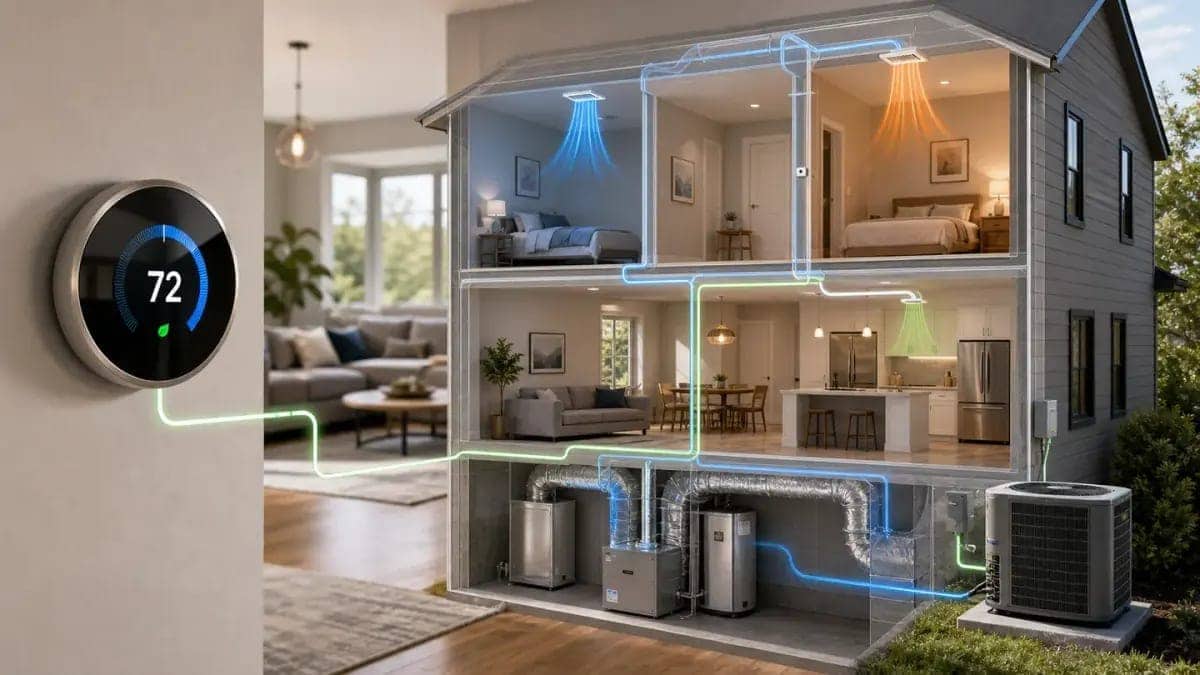
A smart thermostat replaces your old wall-mounted control with a Wi-Fi connected device that schedules HVAC based on occupancy, learns your preferences, integrates remote sensors for true-zone control, and enrolls in utility demand-response programs. Modern units (Nest Learning, Ecobee Premium, Honeywell T9) save 8-15% of HVAC energy on average. Most install in 30 minutes if your existing thermostat has a C-wire. The big differentiator in 2026 is heat-pump-aware behavior — important for any household running or planning to run a heat pump.
Read the full guide 7-min read · how they save · model comparison · C-wire · demand response · privacy considerations
Frequently asked questions
How much does a smart thermostat cost installed?
Hardware ranges from $90 (basic Wi-Fi) to $280 (Nest Learning, Ecobee Premium with remote sensors). DIY install is free and takes 30 minutes for most homeowners. Pro install adds $150–$400. If your system lacks a C-wire (mostly homes with old boilers or pre-2000 furnaces), an electrician adds $100–$350.
Does a smart thermostat actually save money?
Yes, modestly. Nest's 2015 white paper "Energy Savings from the Nest Learning Thermostat" reported 10-12% heating savings and 15% cooling savings across field studies including an independent utility evaluation. The ENERGY STAR Connected Thermostat specification is more conservative at ~8% combined (https://www.energystar.gov/products/smart_thermostats). For a $1,500/yr HVAC household, that's $120–$180/year — a 1-2 year payback. If you already disciplined-setback by hand, marginal savings drop. The big wins are away/asleep occupancy detection and zone-by-zone scheduling with remote sensors.
Are there rebates for smart thermostats?
The federal 25C credit ended 2025-12-31 and didn't cover thermostats. Many utilities still offer $50–$125 rebates: Mass Save, ConEd, ComEd, PG&E, SoCal Edison, Xcel, NYSEG, and others. Check your utility bill for "EnergyWise" or "Demand Response" programs. Some pay an extra annual incentive ($25–$100) to enroll the thermostat in load-shedding events.
What is a C-wire and do I need one?
The C-wire (common) provides 24V continuous power to the thermostat. Smart thermostats need it because their displays and Wi-Fi radios draw more current than old mercury-bulb units. Most furnaces installed after ~2000 have one. Older boiler systems and very old furnaces often don't. Solutions: (1) Nest can sometimes work without one by pulse-stealing from the R-wire; (2) Ecobee includes a Power Extender Kit; (3) an electrician can add a C-wire run for $100–$300.
Nest vs Ecobee vs Honeywell — which is best?
For most homes we lean toward Ecobee Premium on the spec sheet: multi-sensor support, built-in voice assistant, works without a C-wire, and a broad ecosystem (Apple HomeKit, Google, Alexa, SmartThings). Nest Learning is the most refined hardware and works well with Google Home. Honeywell T9 is the value pick with multi-sensor support at a lower price; avoid Honeywell's lower-tier RTH-series if you want multi-sensor zoning. If you run a heat pump, prioritize a model with explicit heat-pump and auxiliary/backup-heat staging control (Ecobee and Nest both document this) — the wrong staging logic can run expensive resistance backup more than it needs to. Confirm the current spec on the manufacturer's page before buying.