
Heat pump dryer
Heat Pump Dryer Cost Calculator
Cost + operating-savings calculator for heat-pump clothes dryers. Compares ventless, hybrid vented, and washer-dryer combos.
Quick answer: a full-size ventless heat-pump dryer costs $1,400–$2,700. Premium models (Miele, Bosch) $2,200–$3,600. Uses 50–70% less electricity per load than a standard electric dryer. HEEHRA rebate up to $840 for income-qualified households.
Optional — auto-sets state
Installed cost · Full-size ventless (7.5 cu ft) · California
$2,050
range $1,400 – $3,100
Annual savings vs current
$193/yr
Old: $303 → New: $110
Simple payback
10.6 yr
260 loads/yr
Cost breakdown
- Equipment$1,900
- Install (delivery + setup)$150
- Total (mid)$2,050
Why ventless wins
Vented dryers exhaust hot air outside — a hole in your envelope that costs heating dollars. Ventless heat-pump dryers recover the heat into condensate, no exterior vent needed. Especially valuable for apartments, condos, and interior-laundry installs where venting is impractical or impossible.
Buying checklist
- · ENERGY STAR Most Efficient certified — best of the best for energy use per load.
- · 120V vs 240V — most full-size models work on a 120V outlet; check before ordering.
- · Drum capacity in cubic feet — match to your typical load size.
- · Condensate drain vs reservoir — drain is preferred but reservoir works in laundry rooms without plumbing.
- · Cycle time — heat pump dryers take 60–90 min vs 40–50 min for vented (acceptable tradeoff for most).
- · Brand network — Miele and Bosch have premium service networks; LG and Samsung have widest parts availability.
- · Stackability if floor space is tight — confirm depth and weight ratings.
- · 5+ year warranty on the compressor — the heat-pump-specific component.
See the single most-likely cost and the realistic range it falls in — not just a low/high band.
- ~25%240V circuit run (gas-to-electric conversion)+$300–$1,200
- PossibleCondensate drain or stacking kit+$100–$400
Surprise odds are approximate planning estimates, not measured rates; cost ranges are sourced where shown. How this works.
Method: each cost line is drawn from a triangular distribution and correlated by a shared market factor (~0.5), then sampled across 10,000 outcomes (a Monte Carlo simulation); the most-likely value and range emerge from the simulation, not the band. A planning simulation, not a quote.
New to heat-pump dryers?
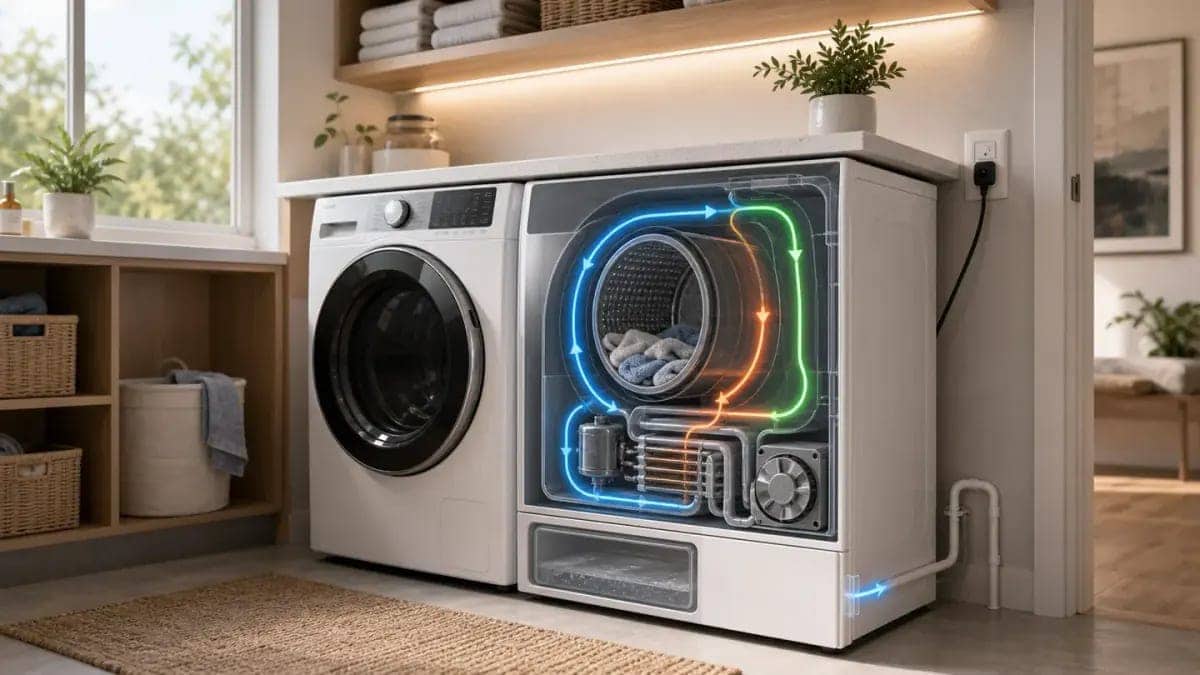
A heat-pump dryer uses a refrigerant cycle to dehumidify clothes at lower temperatures than electric resistance or gas dryers, using one-third to half the energy. Most modern models are ventless — no exterior duct required — which means heat stays inside your home in winter and you can install one anywhere with a 120V outlet and a drain. The tradeoff is longer cycle times (60–90 min vs 40–50 min) and a higher upfront cost ($1,400–$2,700 vs $500–$1,100 for a vented electric dryer).
Read the full guide 7-min read · how it works · ventless vs vented · brand comparison · HEEHRA rebate
Frequently asked questions
How much does a heat-pump dryer cost in 2026?
Compact ventless models (4 cu ft): $900–$1,700. Full-size ventless (7.5 cu ft, most common): $1,400–$2,700. Premium (Miele, Bosch 800 Series): $2,200–$3,600. Hybrid vented heat-pump dryers (Whirlpool, Samsung): $1,100–$2,100. Washer-dryer combos (LG WashCombo, GE Profile): $1,800–$3,200.
Is a heat-pump dryer worth it?
For most households, yes. Heat-pump dryers use 50-70% less electricity per load than electric resistance dryers (1.0-1.3 kWh per load vs 3.3 kWh). For a typical 5-load-per-week household at 16¢/kWh, that's $50-90/yr in savings. Combined with rebates ($100-840 from utility or HEEHRA), payback is usually 3-6 years. Bigger advantage in apartments where you can't vent or in states with expensive electricity.
Ventless vs vented heat pump dryer?
Ventless is the future and dominates the heat-pump dryer market. Heat is recovered from the moist exhaust into a condensate stream that drains away. No exterior vent needed — saves install hassle and avoids the energy penalty of pumping conditioned air outside. Hybrid vented heat-pump dryers exist (Whirlpool) but are a transition product.
How long do heat-pump dryer cycles take?
A typical heat-pump dryer cycle is 60-90 minutes vs 40-50 minutes for a vented dryer. The slower cycle is the tradeoff for the energy savings — the dryer runs at a lower temperature for longer. Most users adapt easily; the cycle time matters most for families running 3+ loads back-to-back.
Will it fit in my laundry space?
Heat-pump dryers come in compact (24" wide, 4 cu ft) and full-size (27" wide, 7.5 cu ft) variants. Most full-size models work on a standard 120V outlet — no 240V circuit needed. Stackable kits available for tight spaces. Verify depth (usually 26-28") and the door swing direction.